

If you’re staring at a GST/HST return while the books are still a mess, you already know the problem. The tax return itself isn’t the hard part. The hard part is figuring out what you collected, what you can still recover, and whether filing now helps your cash position or just confirms a mistake you’ve already made.
That’s why GST HST tax filing matters most when the quarter ends and the numbers still don’t line up. In Ontario, the wrong timing on invoices, refunds, software subscriptions, or owner-paid expenses can turn a manageable return into a cash-flow drag. If you run an incorporated business in the GTA, this is rarely a form-filling exercise. It’s a decision about when money leaves the company, when it comes back, and how much of your margin is getting distorted in the meantime.
The Filing Reality Most Ontario Owners Face
A Mississauga consultant closes a quarter with $84,000 in billings, a Shopify refund to a customer in British Columbia, a few software charges from a U.S. vendor, and a balance that looks more like a refund than a payment. The return looks simple on paper. The books are still open, and every unresolved item changes the number.
The friction is timing, not math
The first question is always the same. Did that sale land in the period you think it did, or did the invoice date and the supply date land on opposite sides of quarter-end? Then the expense side starts to matter. Can the U.S. software charge be claimed, or is the file missing the support needed to back it up?
Good GST HST tax filing starts before the return is opened. Close the books first, then file. If the numbers are still moving, the return becomes a guess with a government form attached. That guess is expensive because it distorts the company’s cash position and can make a refund look like income, or a payment look larger than it should be.
Practical rule: close the books first, then file. If the numbers are still moving, the return is too.
Ontario owners often treat HST as a quarterly nuisance. It is a recurring cash event tied to period-end, and it changes how much money stays inside the company after payroll, supplier bills, and owner draws.
The consultant in this example is not asking whether HST is due. She is asking whether the return is built on clean records or a rushed snapshot that will need fixing later. That difference shows up in cash, and it shows up fast.
Registration Threshold and the Ontario HST Rate
Ontario’s small-supplier threshold is the line that tells you when registration becomes mandatory. If your worldwide taxable supplies are above $30,000 in a single calendar quarter or over four consecutive calendar quarters, you have to register for GST/HST. If you’re at or below that level, you’re generally not required to register, although voluntary registration can still make sense when startup costs are high. The CRA sets out that framework in its GST/HST guidance for registrants, along with the rule that businesses must file for each reporting period, and for periods beginning in 2024 or later, most registrants must file electronically except charities and certain listed financial institutions. CRA GST/HST registrant rules
What the Ontario rate actually means on an invoice
Ontario’s HST rate is 13%, made up of the 5% federal GST and an 8% provincial component. That rate has applied since July 1, 2010, when Ontario joined the harmonized regime. The federal GST was reduced from 6% to 5% on January 1, 2008, which matters when you’re comparing older records or reviewing historical returns. CRA GST/HST rate history
On a $10,000 Ontario taxable sale, HST collected is $1,300. If the price is $1,150 tax-included, the HST embedded in that amount is $132.74. Those numbers sound simple, but they matter because owners often quote prices one way, invoice another, and then wonder why the remittance doesn’t match their expectations.
| Tax Component | Rate | Amount on $10,000 Sale |
|---|---|---|
| Federal GST | 5% | $500 |
| Ontario component | 8% | $800 |
| Total HST | 13% | $1,300 |
If you’re under the threshold, register voluntarily only when the ITCs and future growth justify the admin. If you’re over it, stop treating registration as optional.
The other trap is where the customer is located and where the supply is made. Ontario HST doesn’t automatically apply to every customer just because your business is in Ontario. Online sellers, service businesses, and consultants need to pay attention to where the supply is made and whether the sale is taxed under HST, GST-only, or another provincial regime.
Choosing the Right Filing Frequency
The CRA gives registrants several filing options, but the right one depends on cash flow, not habit. A filing frequency that leaves money trapped with the government is a working-capital problem. A filing frequency that pulls refund claims forward too slowly is also a working-capital problem. The decision should match how predictable your sales and recoverable taxes really are.
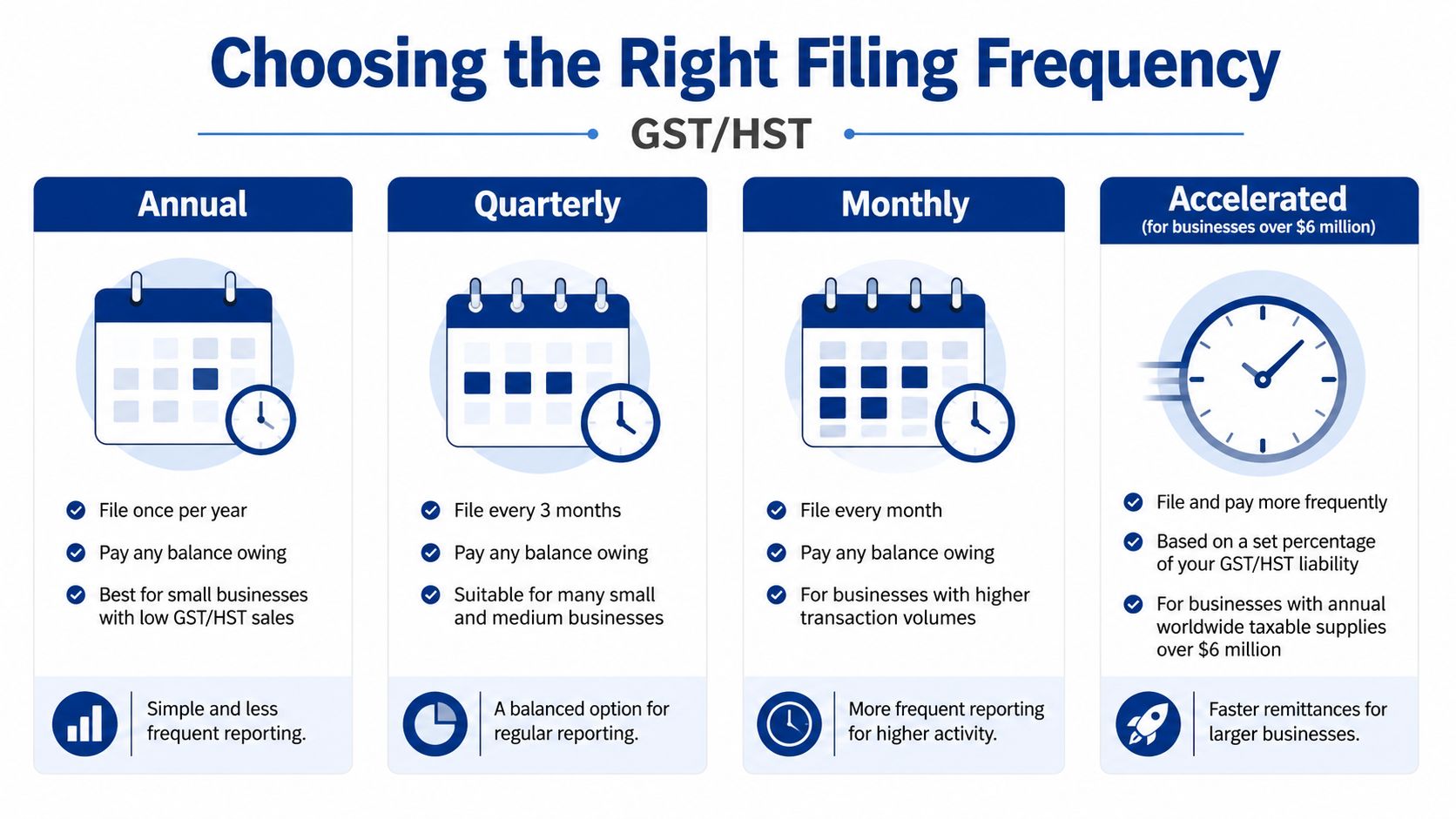
Annual, quarterly, and monthly each solve a different problem
Annual filing can fit a low-volume owner who can fund the eventual payment out of operating cash. Quarterly filing is the default rhythm for most incorporated small businesses because it tracks bookkeeping cycles more closely and keeps surprises from building up. Monthly filing makes more sense when credits and refunds are frequent, because the reconciliation happens sooner and the cash comes back sooner.
The deadline structure matters too. Monthly and quarterly filers generally have one month after period end to file and pay. That’s the kind of date that sneaks up on owners who treat the return as a finance task instead of a month-end discipline.
A simple way to consider it: if your business regularly owes meaningful net HST, longer filing periods are usually a bad deal because the CRA is effectively holding your cash. If your business often generates refunds, a shorter cycle can tighten the feedback loop and reduce the lag between spending and recovery.
Here’s the decision lens I use with owner-managed businesses:
- Annual filing: works only when cash swings are mild and bookkeeping is disciplined.
- Quarterly filing: suits most incorporated Ontario businesses because it keeps tax and books aligned.
- Monthly filing: fits businesses with regular credits, imports, or refund-heavy periods.
- Accelerated filing: only becomes relevant at much larger scale, and it’s a different conversation entirely.
For owners trying to clean up a filing calendar that no longer matches reality, a tax-season review like the one at C&P Partners’ tax season checklist is more useful than another reminder to “be organised.” The file needs to match the business, not the other way around.
How to Calculate and Remit HST
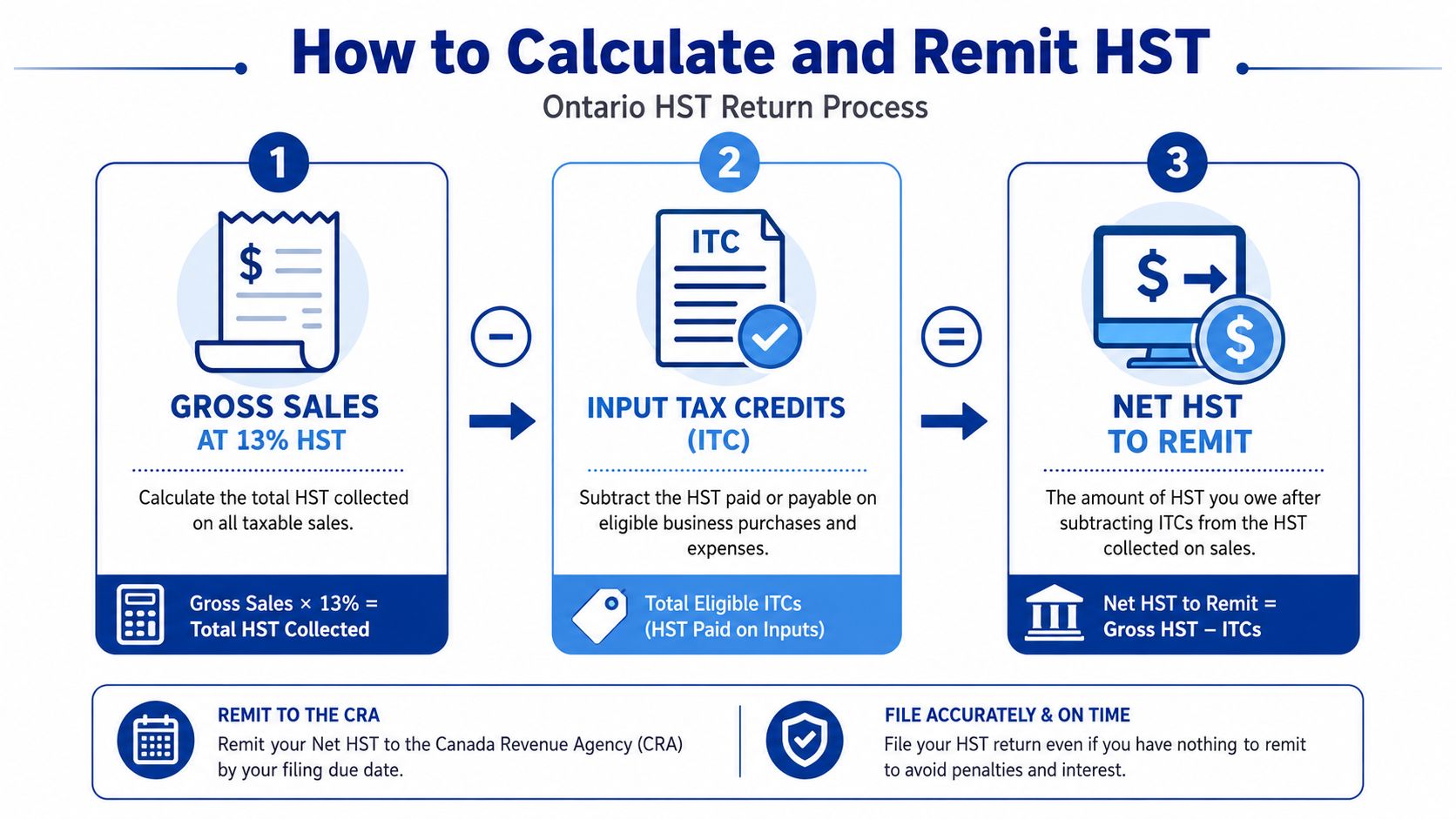
The return is just a reconciliation. Start with the tax you collected on taxable sales, subtract the input tax credits you can support, then account for any prior-period adjustments. That’s the number the CRA cares about. If the books are wrong, the return is wrong too.
A worked Ontario example
Take a Mississauga consultancy with $180,000 in fees for the quarter. At Ontario’s 13% HST rate, tax collected is $23,400. If the company has $9,200 of properly supported ITCs on software, rent, and a vehicle lease, the net remittance is $14,200.
That’s the number to fund before the filing deadline. Not after. Not once the bank balance “looks better.” Before.
The reverse is just as important. A contractor with $90,000 in revenue and $14,800 in recoverable ITCs can end up with a refund position instead of a payment. That’s not a windfall. It’s a timing result. The business spent cash earlier, and the tax system is now repaying part of it.
Cash-flow insight: if the return keeps flipping between payment and refund, your bookkeeping timing is probably inconsistent, not your tax rate.
The CRA supports GST/HST NETFILE through My Business Account or Represent a Client, GST/HST Internet File Transfer through compatible accounting software, and GST/HST TELEFILE by phone. It also requires a return for every reporting period, even when there are no transactions or no net tax owing. CRA filing methods and zero-return rule
The payment side is separate from the filing side. The return can be filed electronically, but the remittance still has to land properly through a Canadian financial institution. If the cash isn’t moved before the deadline, the filing doesn’t rescue you from the interest or penalty clock. https://www.youtube.com/embed/5kKWOg5xgx8
Input Tax Credits Owners Routinely Miss
A lot of owners talk as if every HST charge on a business invoice comes back automatically. It doesn’t. The expense has to relate to commercial activity, the supporting documentation has to be there, and the treatment has to match what was consumed in the business. If you claim aggressively without checking those points, you don’t have a planning strategy. You have a review risk.
The four-year window helps, but it also hides bad bookkeeping
CRA guidance says ITCs are generally claimed in the return for the reporting period when the purchase was made, and most registrants have up to four years to claim them. That window is useful for late bookkeeping, but it also creates a bad habit. Owners assume they can “deal with it later,” and later never comes. The result is money left unclaimed on the table, especially in incorporated businesses with capital items, professional fees, or mixed-use expenses. CRA ITC guidance
Mixed-use items are where mistakes often happen. A law firm’s software subscription used partly for client work and partly for a personal project is not a full-credit item by default. Neither is a vehicle that crosses between personal use and business use, or a restaurant owner’s phone and internet bill. The owner has to decide how much of the supply belongs to commercial activity and support that position.
Here’s the practical approach:
- Commercial use only: full ITC treatment is usually straightforward if the records support it.
- Mixed-use expenses: claim only the business portion, not the full invoice.
- Old invoices: review whether anything was missed inside the claim window.
- Weak documentation: don’t force a claim you can’t support later.
The worst pattern is not overpaying HST. It’s underclaiming it for years because nobody reconciled the expenses properly.
In practice, some businesses use prescribed methods or quick-method structures to simplify how tax is handled. That can be sensible, but it needs to be intentional. If you run a private Ontario company with owner-managed spending crossing personal and corporate lines, the key question is whether the filing method is helping cash flow or just hiding unrecovered tax.
For owners who want the filing side tied back to statements, expense categorisation, and entity-level decisions, financial statement review guidance belongs in the same conversation as the GST/HST file itself. The return and the books should agree.
| Expense Category | Common Use Case | Default ITC Treatment | Owner Decision Required |
|---|---|---|---|
| Software subscriptions | Client work plus personal use | Partial, based on business use | Decide the business-use percentage |
| Vehicle costs | Business travel plus personal driving | Partial, based on use | Track and support usage carefully |
| Phone and internet | Mixed household and business use | Partial, not automatic | Separate personal from commercial use |
| Professional fees | Corporate advice or accounting support | Often claimable if business-related | Confirm the service was for the corporation |
| Office or lease costs | Premises used for operations | Usually claimable where support exists | Keep lease and occupancy records clean |
Common Pitfalls and What They Actually Cost
The CRA’s penalty formula is one of the reasons I push owners to file on time even when the books aren’t perfect. The late-filing penalty is calculated as A + (B × C), where A is 1% of the amount owing, B is 25% of A, and C is the number of complete months overdue up to 12 months, which creates a maximum late-filing penalty of 4% of the amount owing. Overdue amounts also accrue interest at the basic rate plus 4%. CRA late-filing penalty rules
The expensive mistakes are predictable
Take a $20,000 quarterly remittance filed six months late. Under the CRA formula, the penalty is about $3,000 before interest. Add repeated filing failure, bad remittance timing, or any other administrative cost, and the total bill becomes much uglier than the original tax.
The electronic-filing rule is its own problem. For periods beginning in 2024 or later, most GST/HST registrants must file electronically, with exceptions limited to charities and selected listed financial institutions. If a registrant ignores that requirement, the CRA starts with $100 for the first non-electronic return and $250 for each subsequent one. That’s separate from any balance owing.
The common traps are boring, which is why owners miss them:
- Late books: the return gets filed from memory instead of records.
- Wrong filing frequency: the company stays on a schedule that no longer matches the scale of the business.
- Overclaimed credits: full HST is claimed on mixed-use costs.
- Ignored election timing: the business keeps using a structure that traps cash longer than necessary.
Practical rule: if the return is routinely late, the problem is the month-end process, not the tax form.
The biggest cost isn’t always the penalty line. Sometimes it’s the refund you never claimed, the ITC you booked too early, or the cash you left sitting with the CRA because nobody reviewed the filing method. For a private Ontario business, that lost liquidity is real money.
Turning HST Filing Into a Year-Round Conversation
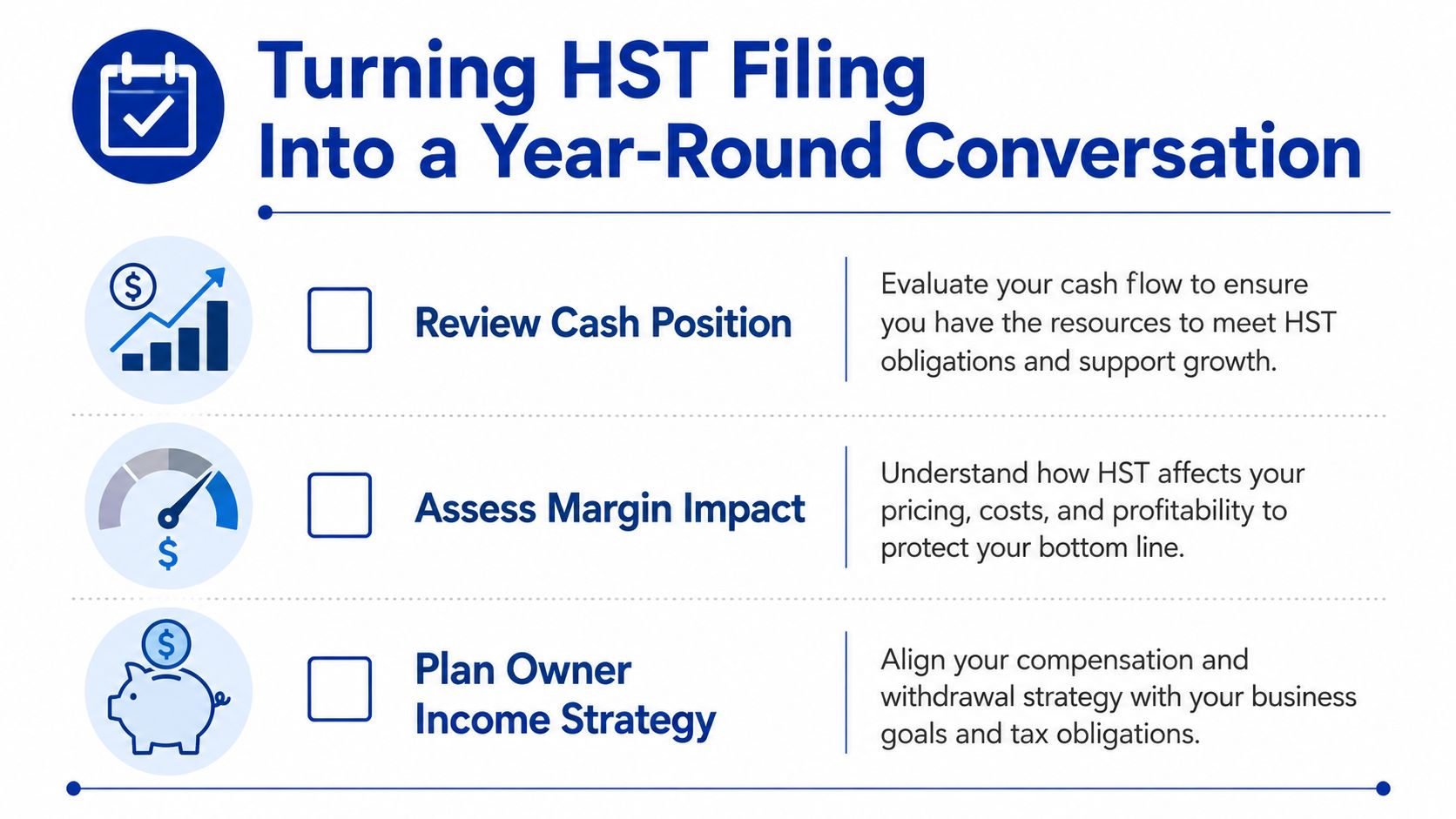
When HST filing is treated as a one-off deadline, the business keeps repeating the same mistakes. When it’s treated as a recurring management checkpoint, the owner gets better numbers, cleaner cash flow, and fewer ugly surprises at year end. That’s the right way to think about gst hst tax filing in an incorporated Ontario company.
Use the filing date to force a management review
Every quarter should trigger the same questions. Is the cash position strong enough to fund the remittance? Did any new expense categories show up that need ITC review? Does the current filing frequency still fit the scale of the business? If the answer to any of those is no, the issue belongs in the books and the owner’s planning calendar, not in the next panic filing.
This matters even more when personal and corporate spending overlap. HST recoverability, deductible expenses, and owner income planning often live in the same file. If the HST return is closed after year-end planning is already underway, the owner is making dividend, payroll, or draw decisions without a clean tax picture.
The best signal that something needs to change is a return that keeps coming back refundable when the business expected to pay, or payable when the owner thought there’d be a refund. That pattern usually means the accounting cadence is off, not that the business is somehow unusual. It’s a timing issue that needs to be fixed at the source.
For owners who want year-end work to stop being a surprise, starting planning in September instead of December is the better habit. By the time the HST return is due, the planning window is already open.
If you want your HST filings cleaned up, your ITCs reviewed properly, and your filing rhythm aligned with the way your business moves cash, reach out to us at welcome@cppartners.ca or call us. C&P Partners CPA handles GST/HST filings, reconciliation, input tax credit review, and audit support for owner-managed businesses in Ontario.