

Fractional CFO Services Explained
You’re in the GTA, your bookkeeping is current, and your tax filings are being handled. Then a decision arrives. Should you hire? Buy equipment? Borrow? Change how you pay yourself? The numbers on hand may describe what already happened, while leaving you unsure what the decision will do to cash, tax, and risk.
You may reasonably think a CFO is for a much larger company. That belief makes sense when you picture a full-time executive, a permanent salary, and a broad corporate finance department. Fractional CFO services provide senior financial leadership on a part-time, defined basis, giving you forecasting, performance analysis, and decision support without a full-time CFO commitment. The cost of deciding without that visibility can appear as a cash shortfall, an avoidable tax result, or a commitment you can’t comfortably reverse.
The practical benefit is simpler. You can answer, “Can we afford this, what happens if the plan changes, and which option protects the business?”
You Are Making Big Decisions Without a Finance Lead
You may be running a construction company with three subcontractors and a truck. You may be leading a professional practice with staff, a corporation, and personal investments. You may have grown quickly enough that payroll, GST/HST remittances, debt service, and owner drawings now compete for the same cash.
The immediate question rarely sounds like, “Do I need a CFO?” It sounds like, “Can I afford another hire?” or, “Should I take this distribution?” Your accountant may prepare the return correctly, yet the return arrives after the decision. Your bookkeeper may keep the ledger current, yet the ledger won’t necessarily show whether next month’s commitments fit the cash available.
A fractional CFO works before the decision. The work is scoped around the issue in front of you, such as hiring, borrowing, changing compensation, buying a property, preparing for a sale, or managing a period of rapid growth.
The standard: Fractional CFO services are senior financial leadership delivered on a part-time or project basis, with the scope tied to the decisions your business needs to make.
That’s different from asking someone to “look over the books.” A CFO-level adviser tests assumptions, builds forward-looking scenarios, identifies pressure points, and explains the trade-offs in plain language. You still need accurate accounting. You also need someone to connect that accounting to what happens next.
The Canadian operating environment already supports this kind of flexible access to expertise. Statistics Canada reported that 52.2% of businesses outsourced tasks, projects, or short contracts in the previous 12 months, while businesses with one to four employees were less likely to outsource than businesses with 100 or more employees, at 45.5% versus 66.8%. The figures are reported in this Canadian overview of fractional CFO services. For a growing owner-managed business, the question is rarely whether external expertise is legitimate. It’s whether the expertise is connected to the decision soon enough to matter.
What Fractional CFO Services Actually Are
Start with the finance responsibilities you may already have. Each layer answers a different question.
Bookkeeping tells you what happened
Bookkeeping records sales, expenses, payroll, receipts, receivables, and payables. It creates the accounting base. Without it, a forecast has weak inputs.
A clean ledger can show that revenue increased, expenses rose, and profit changed. It may not explain why cash fell, whether a customer delay threatens payroll, or whether a new hire remains affordable if collections slow.
Controllership makes the information dependable
Controller-level work adds structure and review. It can include reconciliations, month-end processes, financial statement preparation, reporting controls, and accounting policy decisions. The emphasis is reliability and consistency.
That layer helps you trust the information. It still may not answer the larger management question: “If we spend this money now, what does that do to our cash position, tax position, and options later?”
CFO leadership turns information into a decision
A fractional CFO supplies the senior judgment between the numbers and the choice. The work may include:
- Forecasting: Building a forward view of collections, payroll, taxes, debt payments, and supplier obligations.
- Scenario planning: Comparing the financial effect of hiring, borrowing, expansion, pricing changes, or a transaction.
- Performance insight: Selecting useful KPIs and explaining what changed, why it changed, and what you can do about it.
- Decision support: Helping you choose an action while the alternatives are still open.
Think of the role as a co-pilot for financial decisions. You remain responsible for the business and the call you make. The CFO helps you see the route, the fuel position, and the hazards before you commit.
What the service does not replace
Fractional CFO services don’t automatically replace bookkeeping, tax compliance, payroll administration, or required corporate filings. The precise scope depends on your existing finance function and the decision that needs support.
The point is coordination. Your accounting records, tax considerations, cash position, KPIs, and business objectives should inform the same conversation. Year-end compliance describes the past. CFO work helps you use that information before you choose the next move.
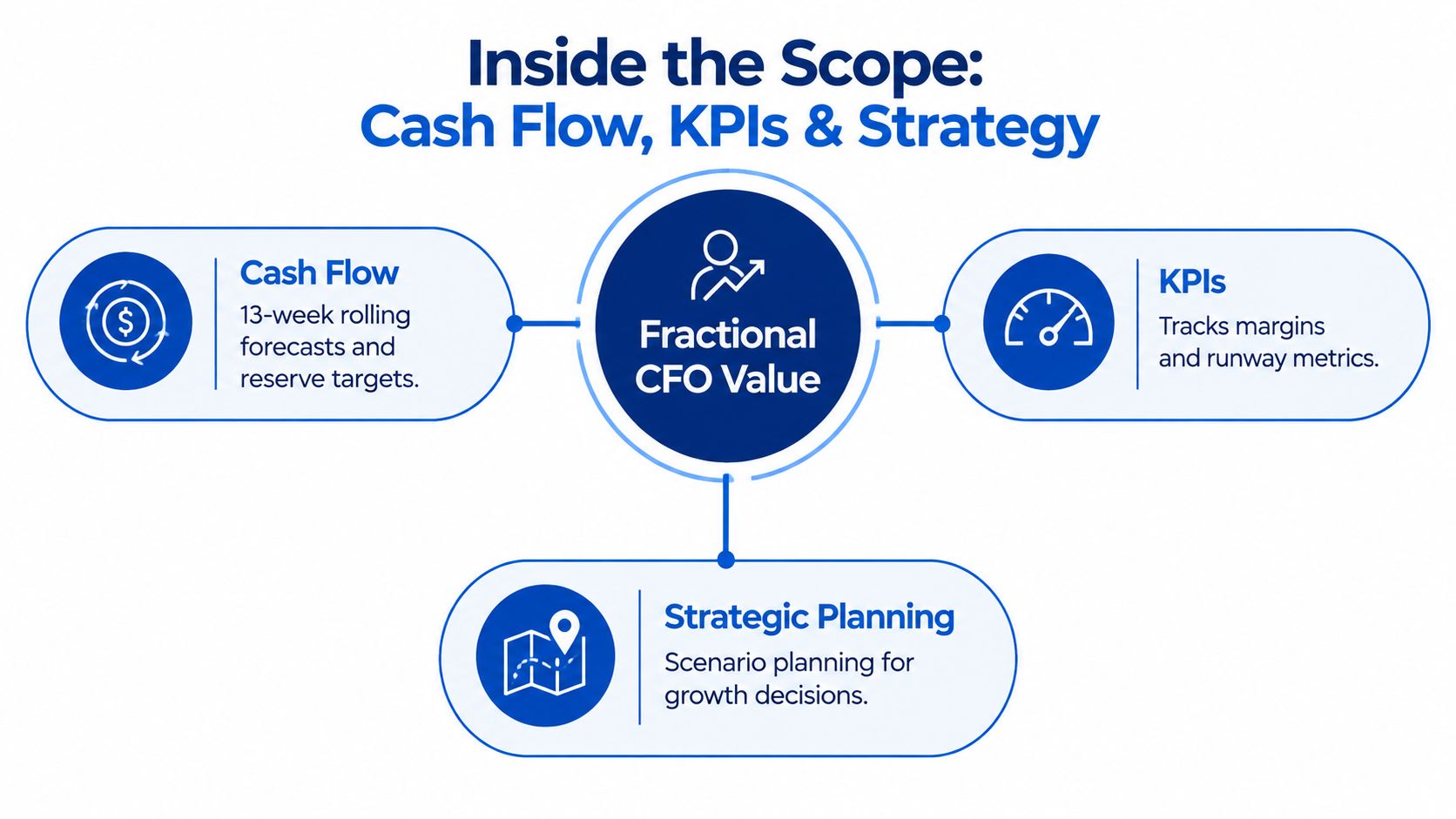
Inside the Scope Cash Flow KPIs and Strategic Planning
The scope usually becomes clearer when you separate it into three connected areas. Each one answers a different owner question.
Cash flow shows whether the plan can survive contact with reality
A practical Canadian SME model is a 13-week rolling cash flow forecast updated weekly, as described in this Canadian cash flow management guidance. The forecast tracks expected collections and disbursements rather than relying on a static annual budget.
That matters when a customer pays late, payroll falls before a receivable arrives, GST/HST remittances become due, or a supplier changes terms. You can model the base case, a slower collection case, and a more aggressive growth case. The purpose is to identify the decision that creates the pressure while there is still time to adjust.
The same guidance recommends arranging a line of credit before the need becomes urgent and targeting a liquid reserve equal to about 60 to 90 days of fixed operating expenses, with 90 to 120 days advised for seasonal or receivables-heavy businesses. Those are planning reference points, not automatic answers. Your business cycle, borrowing access, customer concentration, and payment terms determine what reserve is sensible.
KPIs explain what the bank balance can’t
A bank balance is a snapshot. It doesn’t tell you whether a strong month came from healthy margins, a large customer deposit, delayed supplier payments, or a temporary reduction in inventory.
A CFO can connect selected KPIs to operating decisions. For a contractor, that may mean job margin, work in progress, collections, and change-order discipline. For a professional practice, it may mean billable capacity, realisation, staffing cost, and receivables ageing. For a retailer, it may mean gross margin, inventory movement, and cash tied up in stock.
You don’t need a dashboard full of disconnected measures. You need a small set of indicators that tells you where cash and profit are being created or consumed.
For a broader explanation of how financial statements can support management decisions, see what your financial statements are really telling you.
Strategic planning connects business and personal choices
The third pillar is the decision itself. A hiring plan affects payroll and capacity. A building purchase affects financing, GST/HST, ownership, and personal exposure. A sale affects valuation, tax, timing, and what you do after closing.
Owner remuneration is a common example. In Ontario, salary is deductible to the corporation as compensation expense, while dividends are not deductible in computing corporate taxable income. The tax mechanics differ by income type and province. The cited owner-manager remuneration analysis shows a divergence of about 1.88 percentage points between the top combined personal tax rates for salary and non-eligible dividends in its referenced Ontario comparison table.
That comparison doesn’t choose the answer for you. Salary may affect payroll compliance and retirement planning. Dividends may produce a different corporate and personal result. The right decision depends on your wider facts, which is why compensation should be planned across the corporate and personal picture.
Why Cash Pressure Makes This Role Matter Now
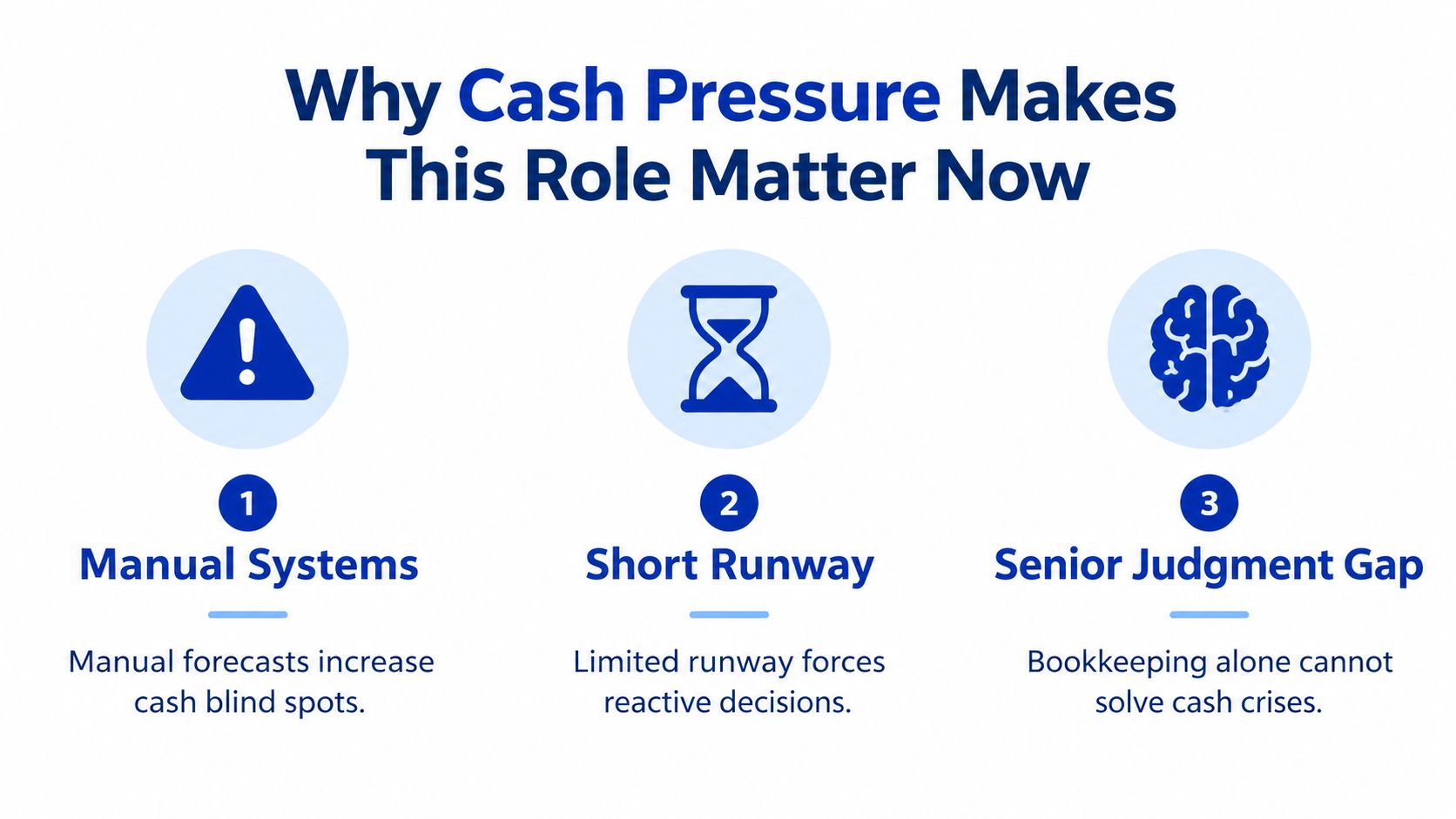
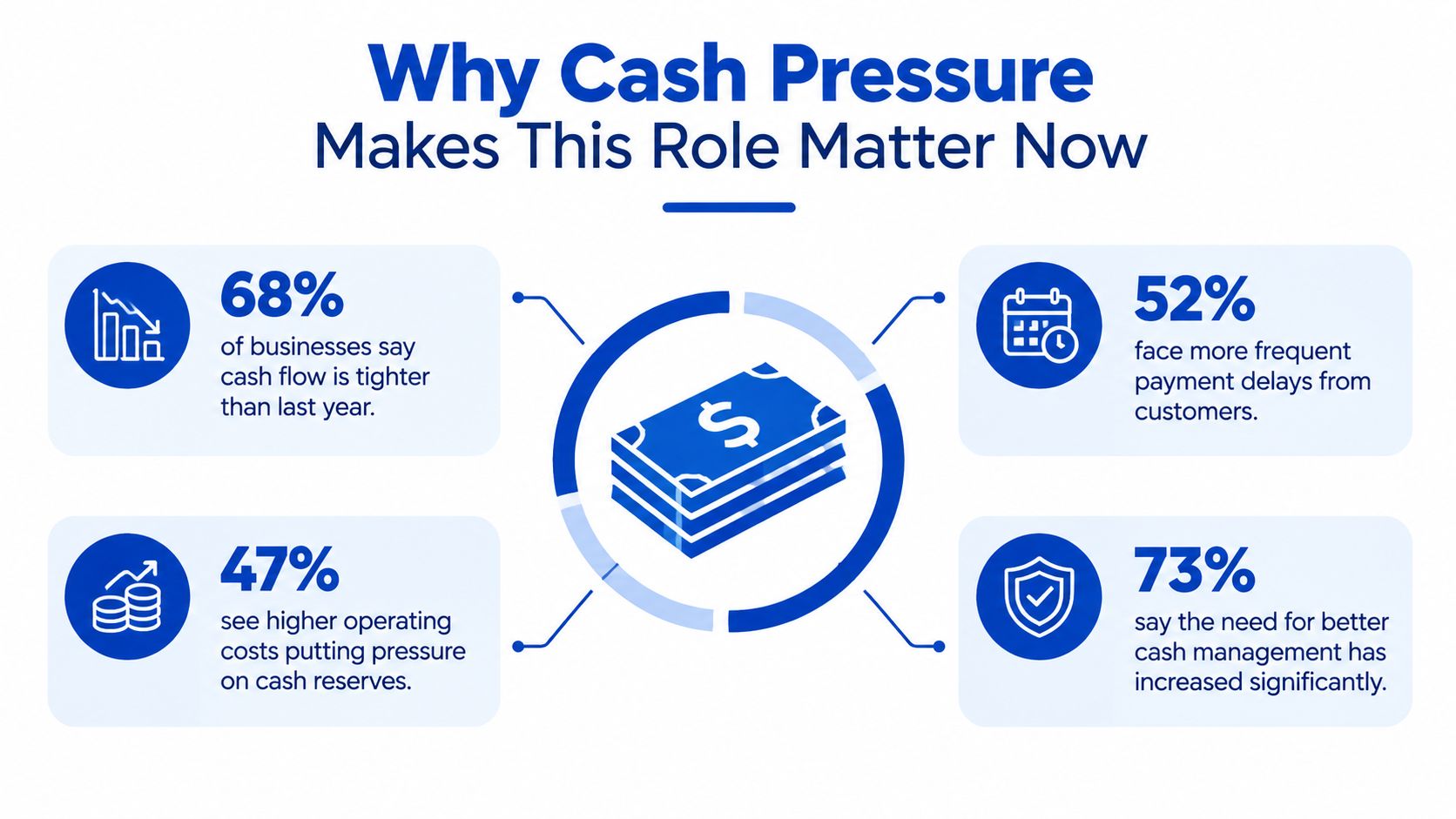
Cash pressure often starts as a visibility problem. You may have accounting software, bank feeds, spreadsheets, and current records. Yet you still can’t answer with confidence when cash will arrive, which obligations are fixed, or what the next decision consumes.
A Canada-wide Xero survey of 1,033 small and medium-sized businesses found that one in three small businesses had less than one month of cash runway. The businesses surveyed had up to 50 employees. The finding is reported in this overview of fractional CFO costs and cash pressure in Toronto.
A separate Canadian SME survey found that 60% reported cash flow management challenges, while 42% still managed cash flow manually with spreadsheets, paper records, or manual calculations. Those figures appear in Canadian survey data on SME cash flow management.
Three ways to handle the gap
| Approach | What you gain | Where it can fall short |
|---|---|---|
| No CFO-level support | Lower immediate advisory cost and familiar routines | You make decisions with limited forward visibility |
| Full-time CFO | Dedicated executive ownership of finance | A permanent executive structure may exceed your current need |
| Fractional CFO | Senior judgment focused on a defined decision or recurring need | The engagement depends on clear scope, timely records, and owner participation |
The consequence deserves a plain name. If you miss the cash gap, you may commit to hiring, debt, inventory, or distributions before recognising that payroll, remittances, or debt service arrive first. That can force a rushed borrowing decision or make a good business decision harder to execute.
The answer isn’t more reports for their own sake. It’s a repeatable process that gives you an early warning and a clear response. A weekly forecast, an agreed KPI set, and a scheduled management conversation can turn a bank balance into a decision tool.
Who Benefits Most From Fractional CFO Services
The strongest fit is usually an incorporated GTA business where the owner has reached a decision that basic accounting can’t settle.
You may have a company with meaningful operations, staff, receivables, and debt. Revenue can be around $1M to $20M, the range C&P Partners CPA identifies for the privately held businesses it serves, but size alone doesn’t determine fit. The trigger is complexity. You’re making commitments that affect cash, tax, financing, ownership, or your personal position, and you want someone senior involved before the choice is locked in.
The owner facing a growth decision
You’re considering another hire because demand is strong. Your instinct says the hire will create capacity. A finance lead tests the timing, payroll effect, collection assumptions, and downside case.
You’re deciding whether to buy equipment or borrow. A forecast can show the difference between a purchase that supports delivery and one that leaves too little liquidity for ordinary obligations.
The owner whose finances are connected
You draw from the corporation, own rentals, hold investments, or receive equity compensation. A corporate decision may change your personal tax, cash requirements, or retirement planning.
The issue isn’t that these matters are impossible to understand. The issue is that treating them as separate files can hide the trade-off. Compensation, financing, and tax planning need to be considered together when the owner and corporation rely on each other.
The owner approaching a transition
A sale, succession, estate administration, separation, or acquisition changes the questions. You may need a defensible value, cleaner reporting, better working-capital information, or a plan for what transfers and when.
An independent valuation has a specific CRA relevance in share-transfer contexts. The transferring individual must provide a valuation report that independently assesses fair market value, and the valuator is expected to be unrelated to the corporation or vendor with appropriate valuation and industry knowledge, as explained in this guide to independent business valuations for tax planning. Transaction work should begin while the alternatives remain open. Further context is available in this practical guide to transaction advisory for owners.
A pre-revenue startup looking only for the cheapest filing may need a different model. So may an owner who wants no conversation attached to the numbers. Fractional CFO services create value when you’re willing to discuss the decision, share the relevant facts, and act on what the analysis shows.

How a Senior Led Scoped Engagement Works
A useful engagement should be easy to picture before it starts. You should know who is involved, what decisions the work supports, what information is needed, and how often you’ll review the results.
The first stage establishes the decision
The opening conversation should identify the immediate issue. That might be cash pressure, a growth plan, compensation, a financing request, or a transaction. The adviser then reviews the current accounting, reporting process, cash commitments, and relevant tax or ownership considerations.
The scope should be agreed in advance. It may include a forecast, management reporting, KPI analysis, decision modelling, and scheduled meetings. It should also say what falls outside the engagement. Clear boundaries protect both sides from a vague arrangement that grows without agreement.
The working rhythm keeps advice current
A practical rhythm may include:
- Weekly cash updates: Refreshing the rolling forecast with actual collections and disbursements.
- Periodic reporting: Reviewing the income statement, balance sheet, cash movements, and selected KPIs.
- Scheduled insight meetings: Discussing what changed, what needs attention, and which decision is approaching.
- Project support: Increasing attention during financing, an acquisition, a sale, rapid growth, or a restructuring.
The senior person who understands the situation should be available for the conversation. That avoids a model where a junior prepares the analysis and a senior reviewer appears only after the relevant decision has passed.
What the first 90 days should produce
You should expect a clearer information base, an agreed reporting rhythm, a first view of cash pressure, and a short list of decisions that need attention. The exact deliverables depend on the records and scope. A good engagement makes the next action visible rather than producing a thick report that nobody uses.
| Model | Best For | Senior Access | Scope and Cost Clarity |
|---|---|---|---|
| Bookkeeping or compliance support | Recording activity and meeting filing obligations | Usually limited to the assigned accounting work | Clear for recurring tasks, limited for decision support |
| Full-time CFO | Businesses needing continuous executive finance leadership | Dedicated internal access | Broad commitment with a permanent employment cost |
| Fractional CFO engagement | Owners needing senior judgment for defined priorities | Scheduled access to a senior finance lead | Agreed scope and pricing before work begins |
| Ad hoc advice | A single question or urgent issue | Depends on the adviser | Can be narrow, with limited continuity |
Pricing should reflect the agreed scope, cadence, complexity, and senior involvement. You shouldn’t have to guess what is included or discover the boundaries only after the work begins.
Getting Clarity Before Your Next Decision
The reason fractional CFO services matter is straightforward. A business decision has a financial shape before it has a financial result. You need to see that shape while you can still change the decision.
That means connecting cash flow to the operating plan. It means reading KPIs as signals rather than decoration. It means considering corporate tax, personal tax, financing, remuneration, and ownership together when your facts require it. It also means recognising when a number needs stronger support, such as an independent valuation for a transfer or succession matter.
You can test your readiness with two questions:
- What decision is open right now? Name the hire, purchase, borrowing choice, compensation change, transaction, or growth plan.
- Which answer is missing? You may need to know whether cash can carry the plan, whether margins support it, how tax changes the outcome, or what happens if the assumptions fail.
If you can name both, you likely don’t need a generic finance package. You need a scoped conversation tied to the decision. C&P Partners CPA provides fractional CFO advisory alongside tax, accounting, GST/HST, payroll, transaction, and valuation work, so the relevant pieces can be considered together when your situation calls for it.
For common questions about accounting and advisory matters, you can review the financial frequently asked questions. If the answer you need isn’t there, that’s useful information too. It may mean the issue depends on your company, your personal position, and the decision in front of you.
The rationale belongs at the end because the work starts with your choice. Finance becomes valuable when it helps you decide with enough clarity to act, preserve options, and understand the consequences before they arrive.
C&P Partners CPA offers senior-led fractional CFO advisory for owner-managed businesses that need clarity around cash flow, KPIs, tax, growth, or a transaction. Visit C&P Partners CPA to start a conversation about the decision you’re facing and the information needed to make it well.