

Strategic Corporate Tax Planning for GTA Business Owners

You’re an owner-manager in the GTA, looking at a strong year and wondering whether to pay yourself a bonus, purchase equipment, retain cash, or wait until December. Waiting feels sensible because the final tax picture won’t be clear until year-end. That assumption makes sense. Your books, personal return, and corporate return often arrive at different times, so tax planning can look like a filing exercise.
The standard is simpler: corporate tax planning must connect corporate income, personal compensation, cash flow, ownership structure, and future goals before decisions become irreversible. By December, a bonus may be harder to fund; an instalment schedule may already have strained cash flow, and an associated-company allocation may have been left unattended.
The question is not whether you can reduce a tax bill after the fact. It’s whether you can choose the right timing and structure while the choice is still open.
Introduction to Corporate Tax Planning
A GTA owner-manager nearing fiscal year-end may be weighing a bonus, equipment purchase, inventory order, shareholder withdrawal, or retained earnings. Each choice reaches beyond the corporate return. Salary can change personal tax, CPP, and RRSP room. Dividends rely on after-tax corporate income. Retained cash may fund growth or an acquisition, but investment income can create passive-income exposure.
A December review often describes the result rather than shaping it. By then, compensation may be difficult to fund, a purchase may no longer fit the business, and cash may already be committed elsewhere.
The practical standard: Review your corporate and personal position while you still have choices.
Start with the fiscal calendar. Record corporate instalment dates, GST/HST remittances, compensation deadlines, and any requirement for associated companies to share a business limit. Cash leaving the company is like water leaving a tank: the annual tax amount matters, but the timing determines how much remains available for payroll, inventory, or investment.
The federal and Ontario thresholds can also point in different directions in 2026. That divergence may affect whether an owner-manager favors salary, dividends, or retained earnings, and whether income should be recognized now or later. It can also influence an eventual sale or succession plan, because compensation and retained value shape both personal cash flow and the assets held inside the corporation.
Earlier review creates room to compare those paths. You may adjust compensation, schedule a purchase, monitor passive income, or reconsider which corporation should hold investments. The goal is not to guess the final tax bill. It is to keep timing, cash flow, and exit choices open long enough to choose deliberately.
Understanding Corporate Tax Planning Fundamentals
Corporate tax planning starts with four questions: when income is recognized, where it is earned, how it is characterized, and how value reaches you personally. The corporate rate is one reference point, not the whole decision.
For 2026, the federal corporate rate is 15%, while Ontario’s general corporate rate is 11.5%. Ontario manufacturing and processing income is taxed at 10%. The combined burden is therefore 26.5% for general income and 25% for manufacturing and processing income, according to the Canada Revenue Agency’s corporate tax rates.

Start with the income classification
A CCPC may claim the Small Business Deduction on the least of its Canadian active business income, taxable income, and business limit. The CRA’s T2 corporation income tax guide states that the deduction is 19% of that least amount, with the business limit generally $500,000 in current guidance.
The practical question is, “What kind of income is this, and does it fit within the available limit?” Active business income, investment income, manufacturing and processing income, and income earned through associated corporations can lead to different results.
That classification also matters in the GTA, where an owner-manager may operate several related companies, retain earnings for a property or acquisition, or prepare for a sale. The 2026 federal and Ontario thresholds do not always point in the same direction. A choice that reduces current corporate tax may affect personal compensation, the timing of withdrawals, or the value left inside the company for a future buyer.
Then connect corporate and personal tax
CRA’s integration principle treats corporate and personal taxation as parts of one system. The intended result is broadly similar total taxation whether income is earned through a corporation or directly, although the timing and final outcome depend on how funds leave the company.
Salary is deductible to the corporation and creates RRSP room. Dividends come from after-tax corporate profits and do not create earned-income room. Ontario’s combined small-business rate is 12.2% on active business income, as described in the discussion of Canadian corporate restructuring and compensation.
Remember what rate cuts changed
Canada’s federal general corporate rate fell from 37.8% in 1981 to 15% by 2012, a cumulative reduction of about 55%. Over that period, the weighted average provincial corporate tax rate for large corporations fell from just over 13% to just over 11.5%, according to this historical analysis of Canadian corporate tax rates.
The lasting lesson is practical: timing, entity structure, and income characterization often matter more than relying on a large statutory-rate gap. Those factors connect today’s compensation decision with tomorrow’s retained value and exit plan.
Timing Strategies for Year-End Optimization
A fiscal year-end is a closing gate. Once it passes, many choices become reporting exercises.
You need to separate three calendars. The first is the corporate income tax calendar. The second is the GST/HST calendar. The third is the operating calendar, which includes payroll, purchases, inventory, contracts, and customer billing.
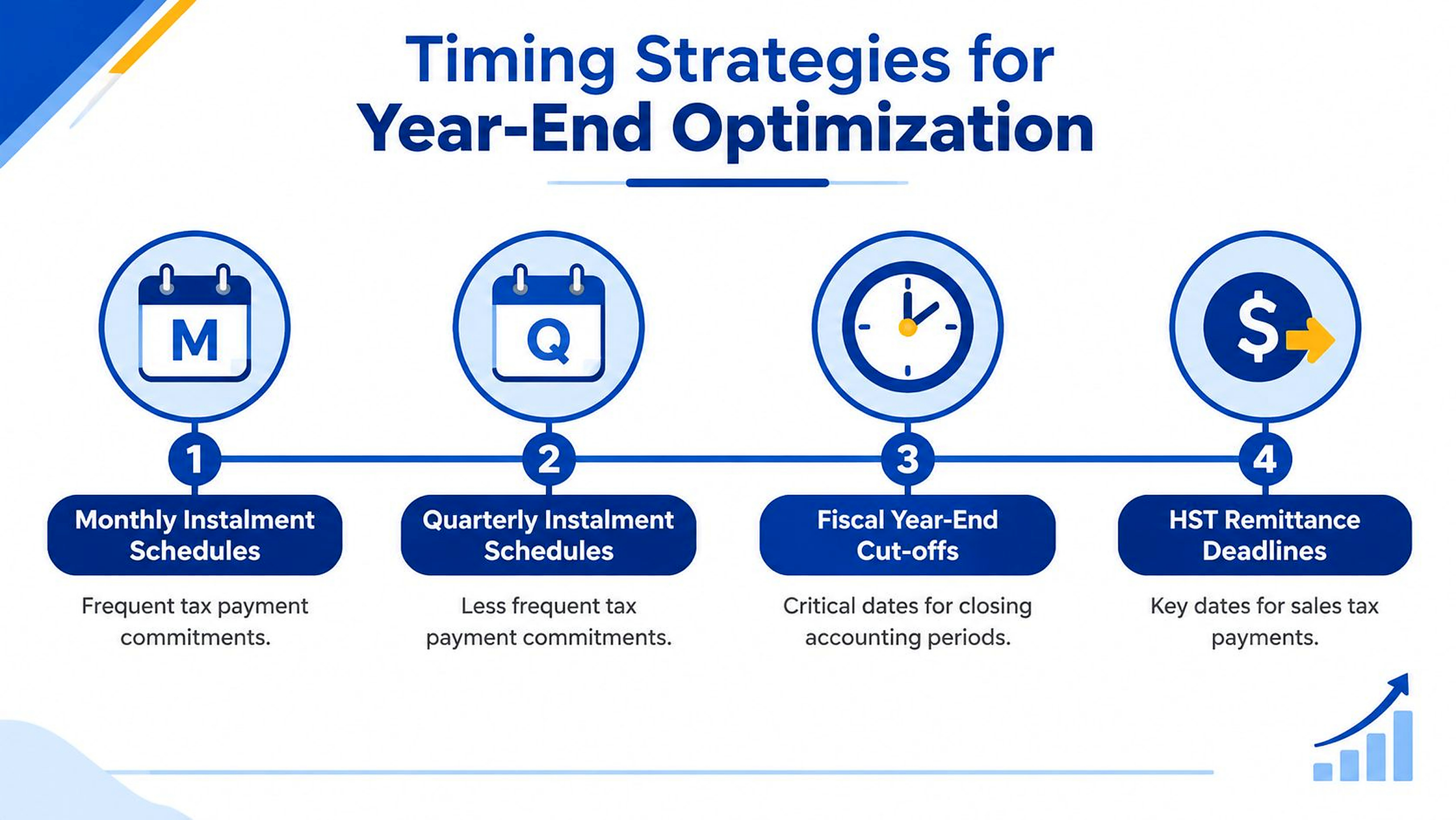
Instalments affect more than compliance
The CRA states that corporate income tax instalments are generally due on the last day of every complete month in the tax year. An eligible small CCPC can pay quarterly instead, with the first payment due one month less a day, or one quarter less a day, from the beginning of the tax year. The CRA instalment dates page sets out those mechanics.
Your forecast should therefore show tax instalments beside payroll, rent, debt payments, and owner compensation. A profitable company can still become cash constrained if tax timing is treated as an afterthought.
GST/HST creates its own deadline
GST/HST collected from customers isn’t operating profit. It’s a liability that must be tracked separately. For corporations that remit GST/HST by instalments, payment is due within one month after each fiscal quarter. The CRA gives April 30, July 31, October 31, and January 31 as example due dates for calendar-quarter filers in its GST/HST instalment guidance.
Input tax credits also need a use-based review. The CRA’s input tax credit rules say ITCs are generally available only for inputs used to make taxable supplies for consideration, and only to the extent those inputs serve that purpose. Mixed-use spending can’t automatically be claimed in full.
Build the plan before the final month
A September review can identify whether a purchase is needed, whether inventory should be reordered, whether a bonus is affordable, and whether a projected tax payment will compete with payroll or debt service. The decision still has to reflect business reality. Buying something solely to create a deduction can leave you with less cash and an asset you didn’t need.
For a practical calendar approach, see why year-end planning should start in September rather than December.
Designing Owner-Manager Compensation Policies
Salary versus dividends is often presented as a one-time choice. Your circumstances change too often for that approach to work.
The right comparison includes corporate cash needs, personal marginal tax, CPP, RRSP objectives, retained earnings, and the company’s access to the Small Business Deduction. Salary reduces corporate income because it’s deductible to the corporation. It can also create RRSP room and CPP contributions. Dividends come from after-tax profits and don’t create earned-income room, as explained in the Canadian corporate restructuring analysis.

Compare the purpose of each payment
| Decision | Salary | Dividend |
| Corporate treatment | Deductible to the corporation | Paid from after-tax profits |
| Personal planning | Creates earned-income room for RRSP purposes | Doesn’t create earned-income room |
| Retirement system | Involves CPP contributions | Doesn’t create CPP contributions |
| Cash policy | Can reduce corporate taxable income | Uses corporate after-tax funds |
The table shows why the answer depends on your objectives. If you need RRSP room and want CPP participation, salary may serve goals that dividends cannot. If the corporation has already paid tax and you want to distribute accumulated profits, dividends may fit the funding source more naturally.
Watch the 2026 provincial and federal split
The Ontario small-business tax change analysis says Ontario’s small-business rate is projected to drop from 3.2% to 2.2% on July 1, 2026, and the provincial business limit is projected to rise from $500,000 to $600,000. The federal small-business limit remains $500,000.
That creates tension for associated corporations. A group may have a larger provincial limit while still facing the federal limit across related companies. Compensation, retained earnings, and limit allocation should therefore be reviewed together. A provincial change doesn’t automatically create more federal low-rate capacity.
Review trigger: Revisit your pay mix when your personal marginal rate, corporate cash needs, or RRSP and CPP objectives change.
For a coordinated review of remuneration and personal-corporate planning, see tax planning services for owner-managers and high-net-worth families.
Structuring Exits and Succession Tax Efficiently
An exit decision made from a tax return is usually made too late. A buyer may prefer an asset purchase, while you may prefer a share sale. A family transition may require different ownership from an arm’s-length sale. A holding company can separate assets from operations, but it also adds legal, accounting, and tax work that must be designed carefully.
The structure should follow the commercial objective. You need to know whether you’re selling operating assets, shares, a property, or a combination. You also need to understand who owns each asset and whether the ownership can be changed before negotiations begin.
Share sales preserve continuity, asset sales offer selectivity
A share sale transfers ownership of the corporation. That can preserve the operating history and contracts, subject to the buyer’s due diligence and the transaction terms. An asset disposition allows a buyer to choose specific equipment, inventory, contracts, or properties, while leaving other liabilities behind.
The tax result can differ sharply between the buyer and seller. You need legal and tax advisers at the same table before signing a letter of intent. A structure that looks efficient for the buyer may create a different after-tax result for you.
Holdcos and estate freezes need a purpose
A holdco may help separate investment assets from an operating company, but it isn’t a universal answer. The ownership, passive income, related-company rules, and future distribution plan all matter. If corporate investment income affects access to the Small Business Deduction, moving assets between companies can change the future tax profile rather than being limited to reducing current tax.
An estate freeze can fix the current owner’s value while allowing future growth to accrue to the next generation or other shareholders. That requires careful valuation, share design, governance, and family communication. A freeze done without a clear succession plan can create ownership disputes even if the tax documents are technically complete.
Start before the buyer or successor appears
The complete guide to selling a business in Canada can help frame the commercial and tax questions. Your working process should include:
- Clarify the transaction: Decide whether the likely path is a share sale, asset sale, family transition, or internal succession.
- Map ownership: Identify the operating company, holding companies, real estate, shareholder loans, and personal ownership.
- Model the cash outcome: Compare proceeds, corporate tax, personal tax, debt repayment, and funds left for the next stage.
- Document the rationale: Keep the commercial purpose, valuation work, and implementation decisions organised before the transaction closes.
A proactive structure preserves options. A last-minute restructure may be difficult to implement, expensive to explain, or poorly matched to the buyer’s requirements.
Real-World Examples for GTA Businesses
The following are illustrative composite examples, not client case studies. They show how the decision process works without claiming a particular client outcome.
A GTA contractor has several active projects, three subcontractors, and a company vehicle. By September, the owner sees that taxable income is likely to be higher than expected. The first instinct is to wait for the year-end financial statements and then ask for a bonus.
An earlier review changes the sequence. The owner examines cash reserves, upcoming payroll, instalments, GST/HST obligations, and personal RRSP objectives. The company considers whether a planned equipment purchase is operationally justified and whether compensation should be paid during the fiscal year rather than improvised after the books close.
The important result isn’t a promised tax saving. It’s a controlled decision. The owner knows what cash the company can distribute, what the purchase is meant to accomplish, and which personal objectives the compensation supports.
What to copy: Use the forecast to make decisions. Don’t use the tax return to discover them.
A second illustrative example involves a family-owned GTA manufacturer with an operating company, a property used by the business, and family members expected to participate in succession. The family initially treats the operating company and property as one package. That makes the future transfer harder to value and harder to negotiate.
The family then maps ownership and separates the commercial questions. Should the property stay with the operating business? Should future growth belong to the next generation? Would an estate freeze fit the family’s goals? Would a holdco improve separation, or merely add complexity?
The family still needs legal documents, valuations, and tax modelling. The planning conversation, however, begins before a transfer date is selected. That gives the family time to test the structure against financing, governance, cash flow, and tax consequences.
Your warning signs may look familiar:
- A fixed pay mix: You’ve paid yourself the same way for years without reviewing cash needs or retirement goals.
- Passive assets in the wrong place: The corporation holds rentals or excess investments, but nobody has projected the effect on the Small Business Deduction.
- A vague exit value: You’re discussing a sale or succession without a current valuation or ownership map.

Conclusion and Next Steps
Good corporate tax planning gives you a decision framework before the deadline arrives. Review your fiscal calendar, instalment obligations, GST/HST position, compensation mix, passive assets, associated corporations, and succession structure as one connected picture.
The 2026 Ontario changes make that review more important for groups near the federal and provincial small-business thresholds. The provincial limit and rate may change while the federal limit remains different. That can affect how you allocate income, retain cash, pay compensation, and plan future distributions.
Your next step should be a short planning review based on actual numbers. Bring the latest corporate financial statements, personal compensation history, projected cash flow, ownership chart, investment assets, and any purchase, sale, or succession timeline. If one company is related to another, include both. A decision made in one corporation can affect the group.
You don’t need to know the answer before starting the conversation. You do need to start while the answer can still influence the outcome.
If you’re unsure which choices remain open, that’s exactly the point at which an advisory discussion is useful. Planning is strongest before the bonus is paid, the asset is purchased, the instalment is due, or the buyer has received the first draft of the deal.
C&P Partners CPA helps GTA owner-managers connect corporate tax planning with compensation, cash flow, entity structure, GST/HST, and succession decisions. Visit C&P Partners CPA to start a conversation about the decisions you need to make before your next planning window closes.