

Tax Planning Business Guide for Ontario Owners in 2026

You are already making tax decisions every time you pay yourself, leave cash in the company, or let a bonus sit until year end. If you run an incorporated GTA business, the core question in tax planning business work is simple, are you choosing the timing of those decisions, or are you letting the calendar choose for you? Waiting until the return is being prepared usually means you have already lost the cleaner options, and you are left with whatever still fits after the fact.
That is why the common belief makes sense. Most owners were taught to treat tax as a filing exercise, something to tidy up in December or hand off in spring. But the standard is different. Tax planning is decision timing while the fiscal year is still open, and the worst cost of waiting is blunt. You can miss a bonus deadline, mis-time income, or lock in a compensation mix that costs more than it should.
Practical rule: if the year has not closed, you still have choices. If the year has closed, you mostly have reporting.
That matters because the benefit is felt in your own cash flow, not in a spreadsheet. You get more control over what leaves the corporation, what stays to fund operations, and what lands on your personal return. In Ontario, that control matters even more now because the rate environment is moving, and the July 1, 2026 change is a planning issue, not a footnote.
You Are Already Making Tax Decisions Whether You Plan or Not
A lot of owners think tax planning starts when the accountant asks for records. By then, most of the useful decisions have already been narrowed. If you are deciding whether to pay salary, declare dividends, or leave profit inside the corporation, you are already in tax planning, whether you call it that or not.
The reasonable mistake is obvious. Filing season is noisy, and filing is when taxpayers first see the numbers pulled together. That makes tax look like a compliance job. The standard is firmer than that. Planning happens while the year is live, compliance happens after the choices are made.
The cost of starting too late
Late planning forces you into the least flexible answer. A bonus that was never formally declared before year end cannot be treated the same way as one that was. A dividend that was never considered earlier may leave you with more personal tax than necessary. Income that could have been deferred is already sitting in the year you did not want it in.
The loss is practical, not abstract. You give up timing control, and timing is where most owner-manager savings live. That is why the smarter owners treat planning as an operating decision, alongside payroll, cash flow, and bank timing.
What the reader actually wants
You do not need more filing help alone. You need a clear read on which payments should happen now, which should wait, and which should be left inside the company because the corporation can carry them more efficiently for the moment. That is the difference between a return that is merely correct and a business that is being run with intent.
What Tax Planning Means for a Business and When It Actually Happens
Tax planning is the work of shaping outcomes while the fiscal year is still open. Compliance is the work of reporting what already happened. Those are related jobs, but they are not the same job, and confusing them is why many owner-managed businesses miss the best window.
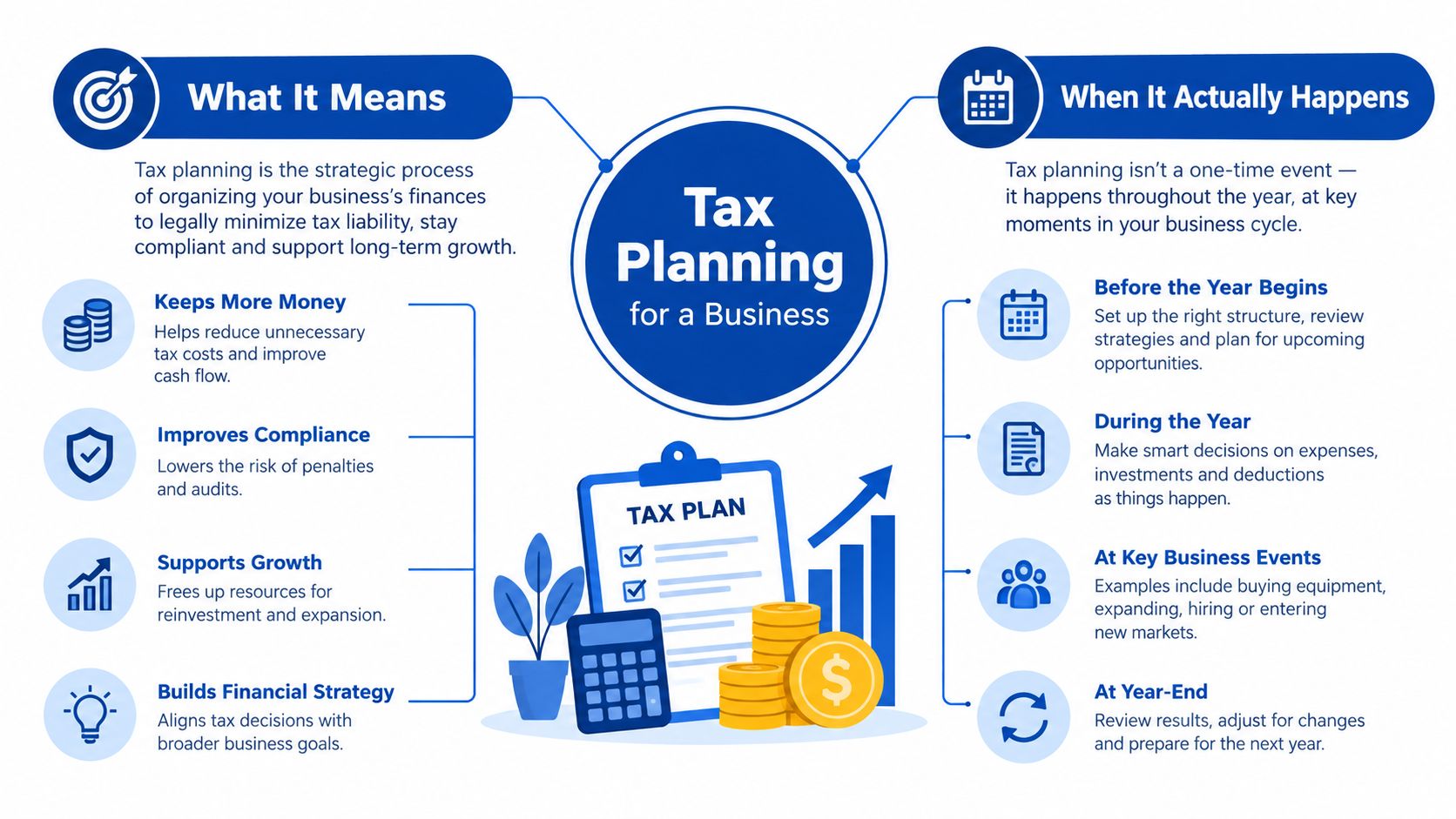
The useful window is before year end
For most owner-managers, the useful stretch is September to November. That is when you still have room to decide on salary, dividends, bonuses, capital spending, and whether income should move this year or next. Once year end passes, you can still file properly, but you cannot recreate a missed timing choice.
That is why a tax planning business conversation belongs before the last month of the year. It is easier to model options when you still have payroll runs left, installment payments still to make, and corporate cash still in motion. A late review can still improve the file, but it usually cannot improve the decision.
Planning asks a different question
A filing question sounds like this, “What do I report?”
A planning question sounds like this, “What should happen before the books close?”
That is the standard. If the answer depends on whether you can still declare a bonus, shift a dividend, or defer a payment, you are in planning territory. If you are just gathering receipts and reconciling accounts after the fact, you are already past the point where the strongest options lived.
Rule of thumb: if you wait until documents are final, you have already accepted someone else’s timing.
For owners who want the point of contact, a good starting read is why year-end planning should start in September, not December. That is where the calendar stops being an administrative detail and starts becoming a tax tool.
How Salary and Dividends Change Your Total Tax Picture
The income you pull from the corporation does two jobs at once. It funds your life, and it changes the tax result on both sides of the ledger. That is why salary and dividends cannot be treated as a preference question only. They have different mechanics, different reporting, and different planning uses.
| Salary Versus Dividend Mechanics for Ontario Owner Managers | Feature | Salary | Dividend |
|---|---|---|---|
| Corporate treatment | Deductible to the corporation | Paid from after-tax corporate profits | |
| Personal mechanics | Reported through payroll on a T4 | Generally reported on a T5 | |
| Retirement and benefit impact | Creates RRSP room and CPP coverage | Does not create RRSP room | |
| Tax mechanics | Subject to payroll deductions and CPP contributions | Uses gross-up and dividend tax credit rules | |
| Planning use | Better when you want RRSP room or CPP accrual | Better when you want simpler extraction from after-tax profits |
Salary is the cleaner answer when you want deductible corporate expense, payroll reporting, RRSP room, and CPP accrual. Dividends are the cleaner answer when you want to pull money from after-tax profits without payroll mechanics. That does not make one “better” in the abstract. It means the right answer depends on what you are trying to build personally and corporately.
Cash today versus benefits later
The trade-off is real. Salary usually creates more immediate payroll friction, but it can support long-term personal planning. Dividends are simpler to distribute, but they do not build RRSP room or CPP coverage. Ontario guidance cited in owner-manager remuneration planning shows a top combined personal rate of 53.53% on salary, 39.34% on eligible dividends, and 47.74% on non-eligible dividends (BDO owner-manager remuneration strategies).
That spread is why owners should stop asking, “Which one is cheaper?” and start asking, “What am I trying to achieve this year?” If the company needs retained cash and you want to preserve retirement room, salary can still be the right call. If the priority is immediate extraction from corporate profits, dividends may fit better.
The reporting difference matters too
For Canadian owner-managers, salary is deductible to the corporation, subject to CPP contributions, creates RRSP room, and is reported through payroll with a T4. Dividends come from after-tax corporate profits, are not deductible, do not create RRSP room, and are generally reported on a T5, with the gross-up and dividend tax credit rules doing the tax work (salary versus dividends in Canada). That is why the mix should be reviewed instead of inherited from last year.
Why Ontario Rate Thresholds Make Timing Your Biggest Lever
Ontario’s corporate rate structure rewards timing discipline. The province has a general corporate rate of 11.5% and a small-business rate that was 3.2% from January 1, 2020 to June 30, 2026, then drops to 2.2% effective July 1, 2026. Ontario also keeps a $500,000 small-business limit in place (Ontario corporate income tax).
That means one dollar of active business income does not always face the same result. Income inside the small-business limit is taxed at a 12.2% combined rate through June 30, 2026 and 11.2% on or after July 1, 2026, while income above the limit is taxed at the 26.5% combined general rate (Ontario small business tax rate). The spread is large enough that deferring or accelerating income can change the marginal corporate tax cost in a way you can feel.
Thresholds are a planning problem, not just a tax rate problem
Owner-managers often make their first expensive mistake here. They see the lower rate and stop there. But if your corporation is near the $500,000 limit, the main job is to watch how compensation, retained earnings, and related active business income interact across the year. A rate that looks lower on paper can still produce a worse outcome if you ignore where the income lands.
The July 1, 2026 change makes this sharper. Ontario’s 2026 budget cuts the CCPC small-business rate from 3.2% to 2.2% effective July 1, 2026, and the change is prorated for straddle-year returns (Ontario 2026 budget annex). A blended fiscal year does not get one neat annual rate. It needs modelling, especially for instalments and year-end decisions.
The question to ask before the year closes
If your fiscal year crosses that date, you need to ask three things before the year ends, not after. What income should be accelerated or deferred? What compensation should be declared? What instalments need to be revisited while the year is still open?
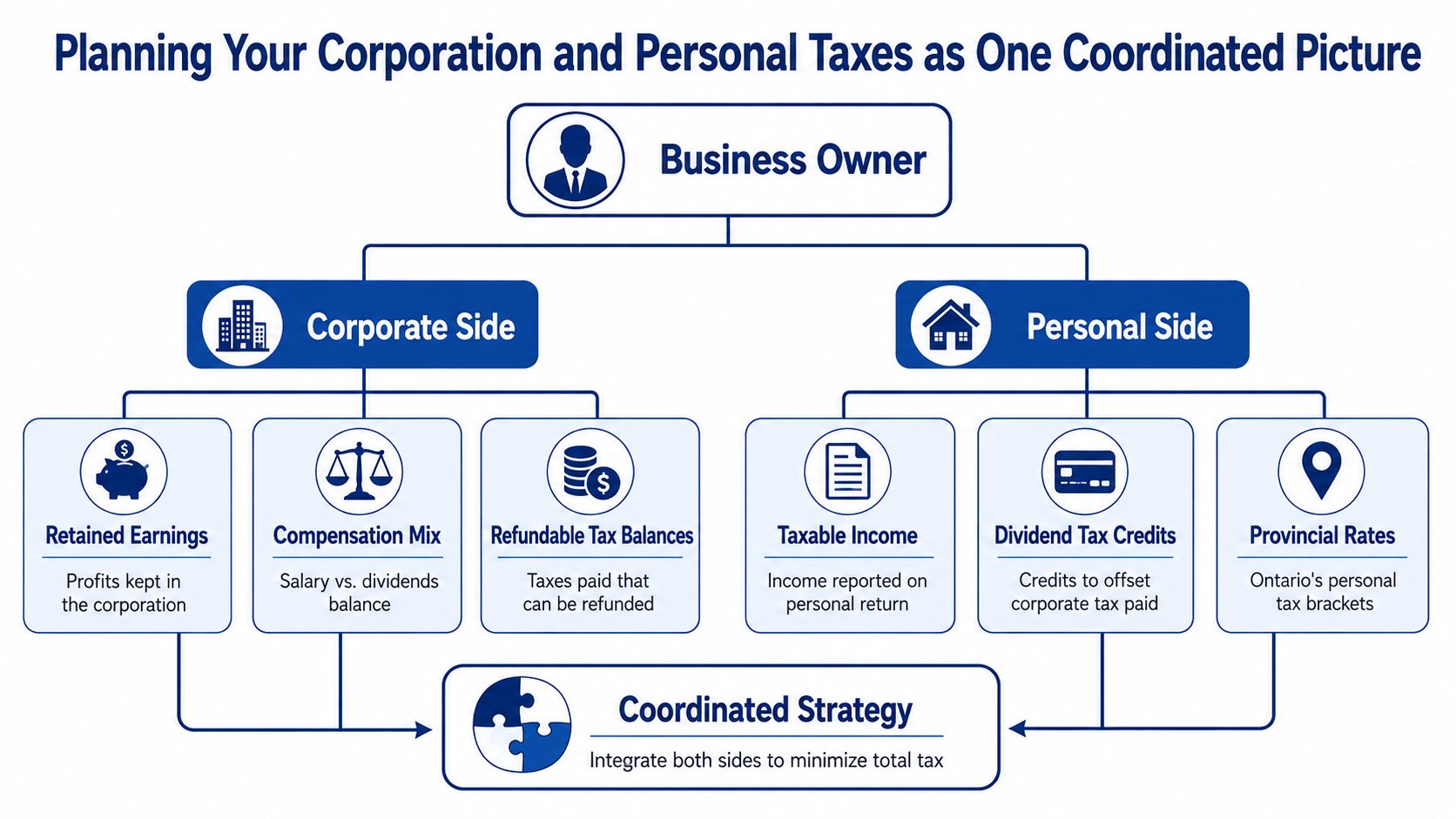
Planning Your Corporation and Personal Taxes as One Coordinated Picture
Owners often treat the corporate return and the personal return as two separate jobs. That is the wrong frame. Retained earnings, compensation mix, refundable tax balances, and provincial allocation all push on each other. A lower corporate rate does not automatically improve the after-tax result if the personal side is left untouched.
One decision, two returns
Take an owner who is considering leaving money inside the corporation while also delaying salary. On the corporate side, cash stays available for operations. On the personal side, the owner may lose the benefits that salary can create. If the company is operating in more than one province, allocation issues can also complicate what looked simple at first.
That is why the right question is total cost to the family and business, not just the corporate bill. When you look at the entire picture, some decisions that seem efficient on one return become less attractive once the personal return is included.
A working habit that helps
Use the corporation as part of the household balance sheet, not as a sealed box. Review the compensation mix before year end. Watch whether refundable balances are being created or trapped. Check whether income that belongs in the lower-rate stream is in danger of spilling over the threshold.
A simple composite example makes the point, and it is illustrative only. An owner who chases the lower corporate rate without checking the personal result can end up with a cleaner T2 and a worse overall family tax position. That is the trap. The better answer is coordinated, not isolated.
For a deeper look at the corporate side of that coordination, see corporate tax planning for owner-managed businesses.
When to Bring an Adviser In and What Good Year Round Planning Looks Like
Good planning has a rhythm. It is not a once-a-year cleanup. It starts when choices are still live, which is why the September to November window matters so much. If you wait until filing season, you are usually asking for a post-mortem, not advice.
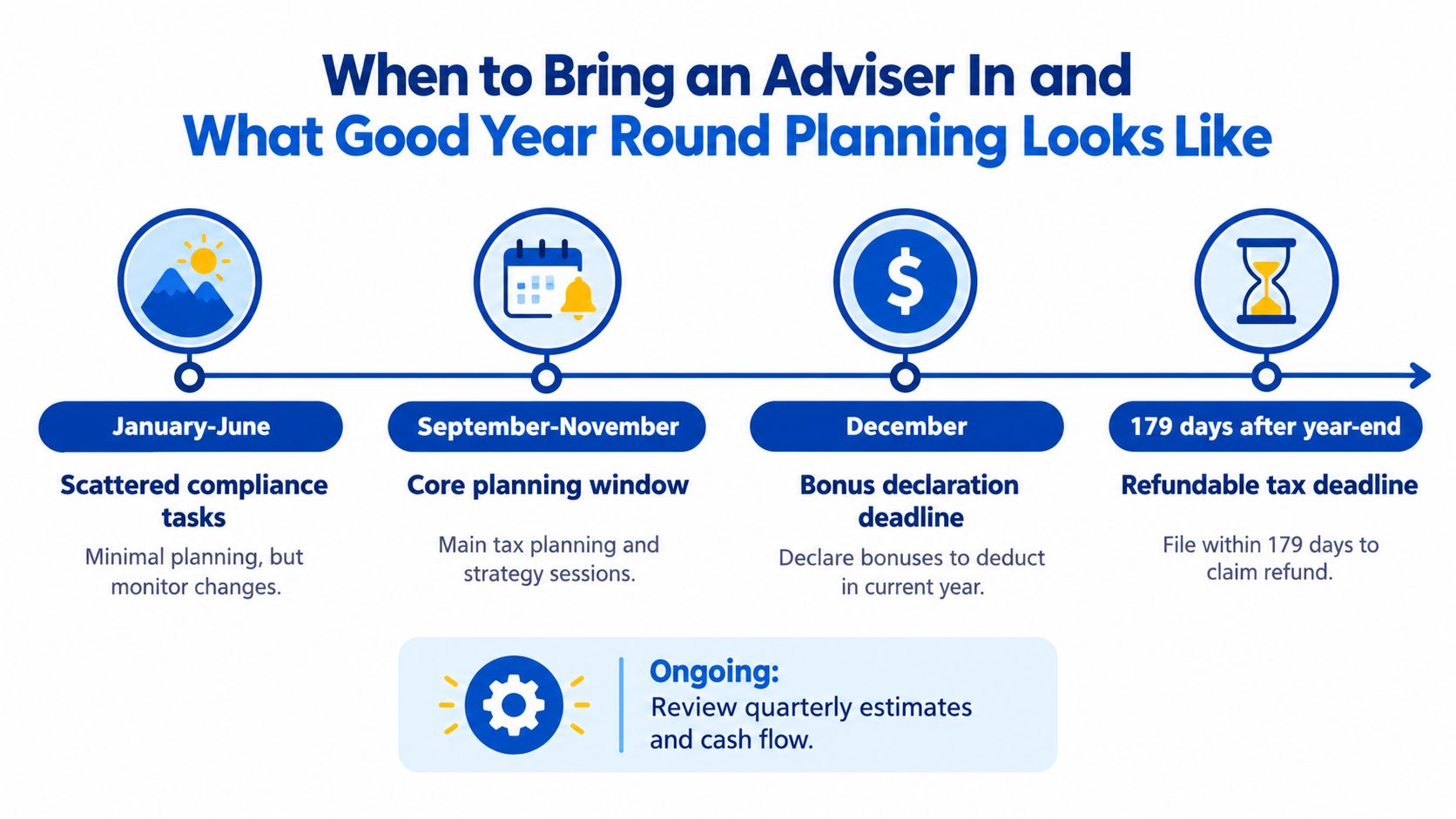
The cadence that keeps owners out of trouble
There are a few hard dates that matter. Bonuses must be formally declared before fiscal year end and paid within 179 days after year end to be tax-effective and CRA-compliant (year-end corporate tax planning strategies). Ontario’s annual return is filed separately from the federal T2 return and, since 2021, must be filed through the Ontario Business Registry within six months of the corporation’s fiscal year-end (Ontario annual return compliance). Those dates matter because missed timing cannot be fixed by good intentions later.
Instalments matter too, especially in a straddle year. If the July 1, 2026 rate change affects your corporation, the instalment cadence deserves a look before the year closes, while there is still time to match payments to the year that is being earned.
Practical rule: if the question is about timing, do not wait for filing. Filing tells you what happened. Planning decides what happens next.
What a useful meeting looks like
A real planning meeting is scoped, senior-led, and decision-focused. It should cover remuneration, threshold exposure, bonus timing, instalments, and whether corporate cash should stay put or move out. If the advice arrives after the books are closed, it is already late.
If you want a firm that works this way, tax planning services for owner-managers and high-net-worth families is the kind of service line that should be built around those decisions, not around form filling alone.
The trigger to pick up the phone
Call when your compensation mix feels stale, when your corporation is near the small-business threshold, when your fiscal year straddles the Ontario rate change, or when you are unsure whether a payment still has time to be made tax-effectively. Those are planning issues. They are not cleanup issues.
A Clear Next Step If You Are Not Sure What Applies to You
The rule exists because tax should follow economic reality, not get invented after the year is over. Income, timing, and reporting all have to line up with what happened in the business. If they do not, you pay for the mismatch in cash, in tax, or in missed flexibility.
If you are not sure whether a salary, dividend, bonus, or instalment change belongs in your year-end plan, that is exactly the kind of conversation worth having before the year closes. The right answer usually comes from looking at the corporation and your personal return together, then choosing timing on purpose.
If you want one straightforward place to start, use the earlier guide on September planning, then compare it with your current compensation mix and year-end deadlines. If the pieces do not line up, that is your signal that the file needs advice, not just preparation.
C&P Partners CPA helps owner-managers, incorporated professionals, and privately held businesses sort out compensation, corporate timing, and year-round tax planning with the corporate and personal sides viewed together. If this is the kind of decision you are facing, visit C&P Partners CPA and start a conversation before the year closes.