

Estate Tax Planning Strategies That Actually Work

You’re the surviving spouse or adult child looking at a Muskoka cottage, a brokerage account, and a will that seemed perfectly adequate when it was signed. The family may assume Ontario probate fees are the main cost. That assumption makes sense because probate is visible, provincial, and easy to calculate. The larger problem often arrives through the deceased person’s final tax return.
Estate tax planning in Canada starts with coordinating two separate charges on the same assets: the capital gains tax created by the deemed disposition at death, and Ontario’s Estate Administration Tax when an estate certificate is issued. The practical objective is to reduce avoidable tax, preserve liquidity, and leave the executor with a plan that can be administered.
The Tax Bill Most Families Never See Coming
A parent dies and leaves a Muskoka cottage worth $1.4 million and a non-registered brokerage account worth $900,000 to two adult children. The surviving spouse expects the probate application to produce the painful cheque.
That expectation is reasonable. Ontario’s probate levy is a government charge tied to the estate certificate, and families often hear about it first from the lawyer handling the application. Yet the larger cheque may go to the Canada Revenue Agency because Canada treats death as a deemed disposition of capital property. The deceased is generally treated as having sold property at fair market value immediately before death, with the resulting gain reported on the final return. The CRA’s explanation of capital gains after death sets out that core rule.
Consider the brokerage account alone. If its adjusted cost base is $300,000 and its value at death is $900,000, the embedded capital gain is approximately $600,000. Under the 2026 rules, 50% of a capital gain is included in taxable income, so the final return could include approximately $300,000 of taxable capital gain before other income, credits, and available planning relief are considered. The tax depends on the entire return and the deceased person’s marginal rates. The point is the scale of the exposure, before probate, legal fees, accounting fees, or cash-flow pressure are added.
The cottage can create the same issue if it has appreciated and doesn’t qualify fully for the principal residence exemption. A spousal rollover may defer the tax where the statutory conditions are met, while a transfer directly to adult children generally requires closer attention to fair market value and the resulting gain.
Practical rule: Never ask only, “How much will probate cost?” Ask, “Which assets will create income on the final return, and where will the cash come from?”
One estate, two tax streams
Ontario Estate Administration Tax applies to value passing through the estate when an estate certificate is applied for and issued. The current rule exempts the first $50,000 and applies $15 per $1,000 above that threshold. Ontario’s Estate Administration Tax guidance explains the mechanics.
The tax bill most families miss is therefore a coordination problem. Ownership, beneficiary designations, spousal rollover planning, corporate structure, charitable gifts, and liquidity all affect the same family outcome. Treating probate as a legal administration issue and the final return as an accounting issue leaves the family to solve the cash crisis after death.
The right question is simple: how do you coordinate the deemed-disposition tax and the Ontario probate levy before the estate has to pay both?
How Death Triggers a Capital Gain in Canada
The deemed-disposition rule is easier to understand if you treat death as a forced valuation event. Immediately before death, capital property is generally treated as though it were sold at fair market value. The difference between that value and the adjusted cost base creates a capital gain, unless a rollover or another specific rule applies.
A spousal rollover can defer recognition where property transfers to a qualifying spouse or common-law partner and the required conditions are satisfied. The tax generally waits until the surviving spouse later disposes of the property or dies. That deferral can preserve cash when the family needs it most.
A portfolio calculation
Assume a non-registered investment portfolio has an adjusted cost base of $250,000 and a fair market value of $1,000,000 at death. Assume there’s no spousal rollover.
| Step | Calculation | Amount |
|---|---|---|
| Deemed proceeds | Fair market value at death | $1,000,000 |
| Capital gain | $1,000,000 minus $250,000 | $750,000 |
| Taxable capital gain | 50% inclusion rate | $375,000 |
| Illustrative tax | $375,000 at about 43% | Near $161,000 |
The 50% inclusion rate remains relevant in 2026 under the currently administered rules, after the proposed increase for certain larger gains was deferred and did not take effect. The CRA’s 2025 update on proposed capital gains changes explains the current administration position. The illustrative tax amount above is a planning approximation, not a universal final-return result. Actual tax changes with other income, provincial rates, deductions, losses, credits, and the deceased person’s broader facts.
This rule applies to more than public shares. It can reach investment real estate, cottages, private-company shares, and other capital property. Principal residence treatment may eliminate the gain in appropriate circumstances, but the exemption still requires reporting and supporting forms.
Different containers produce different outcomes
Corporate assets require separate analysis. Shares of a private corporation are personal property held by the shareholder, while the corporation’s underlying assets belong to the corporation. A transfer to a holding company may avoid an immediate personal deemed disposition in some structures, but it doesn’t erase future tax. A later sale, redemption, or distribution can create shareholder-level consequences.
Registered plans follow their own rules. An RRSP or RRIF can create a large income inclusion on the final return unless a qualifying rollover applies. A TFSA generally passes without the same final-return income inclusion, provided the account and beneficiary arrangements are handled correctly.
For further reading on the personal side of this issue, see C&P Partners’ personal tax planning resources. The planning decision is always fact-specific. The account’s label alone doesn’t tell you the tax result.
Ontario Probate Fees in Plain Numbers
Ontario’s Estate Administration Tax is commonly called probate fees. It is a provincial tax connected to the estate certificate. Estates valued at $50,000 or less owe no tax. Above that threshold, the estate pays $15 per $1,000 or part thereof on the amount over $50,000. The Ontario’s official Estate Administration Tax rules set out this calculation.
The threshold matters. For a $3 million estate, the first $50,000 is exempt. The remaining $2,950,000 is taxed at $15 per $1,000, producing approximately $44,250. That amount is the probate levy alone. It does not replace the tax arising on the deceased person’s final return.
For a $750,000 estate, $700,000 is above the exemption. At the current rate, the EAT is approximately $10,500, often rounded to about $11,000 for planning.
| Estate size | Calculation | EAT payable |
|---|---|---|
| $50,000 | First $50,000 exempt | $0 |
| $750,000 | $700,000 above threshold at $15 per $1,000 | About $10,500 |
| $3,000,000 | $2,950,000 above threshold at $15 per $1,000 | About $44,250 |
The tax is based on the gross value of assets passing through the estate. It is an estate expense and may be deductible in the estate’s tax calculation where the applicable rules allow. The charge arises when the estate certificate is applied for and issued. Assets passing outside the estate may avoid this particular levy, but that result must be weighed against the final-return tax and the ownership consequences.
Probate avoidance can create other problems
Joint ownership with right of survivorship may move an asset outside the estate. Families often consider it for cottages, homes, and brokerage accounts. The arrangement can also create disputes over beneficial ownership, expose the asset to the joint owner’s creditors or relationship breakdown, and reduce the original owner’s control during life.
A joint account with an adult child requires particular caution. The child may be a true co-owner, or may hold the account for the parent’s benefit. Those outcomes affect who receives the funds and how the arrangement is documented. A transfer can also raise attribution, creditor, family-law, and tax concerns.
A lower probate bill is useful only if the ownership structure still reflects the owner’s intentions and leaves the family with a defensible record.
For an owner-manager, probate should be coordinated with the deemed-disposition tax on the final return. Reducing the Ontario levy while leaving a large personal tax liability untouched is not a plan. Review the estate value, ownership records, beneficiary designations, and expected final-return tax together before changing title.
Choosing Where Assets Sit at Death
The same asset can produce a different result depending on how it’s owned and how it reaches the beneficiary. The cheapest route on a probate worksheet can create the greatest family risk if it removes control, exposes the asset to a beneficiary’s creditors, or defeats the will.
| Holding option | Probate tax exposure | Deemed-disposition tax | Control during life | Watch-out |
|---|---|---|---|---|
| Held in the estate and distributed by the will | Usually included in estate value | Usually recognised at death unless a rollover applies | Owner retains control | Probate, delay, and executor administration |
| Joint ownership with right of survivorship | May pass outside the estate | Tax can still arise from the deceased owner’s interest | Shared control | Creditor exposure, disputes, and unclear beneficial ownership |
| Spousal rollover | Assets may still pass through the estate depending on ownership | Can defer tax when qualifying conditions are met | Owner retains control until transfer | The rollover must be documented and implemented correctly |
| Named beneficiary under a qualifying plan or insurance policy | Often outside the estate | Depends on the asset and applicable rules | Owner controls designation during life | Outdated designations, unequal outcomes, and trust concerns |
Use the rollover where deferral matters
The marital home and RRSP or RRIF often require specific spousal planning because the family may need access to the asset and time to fund the final tax. The rollover doesn’t permanently eliminate tax. It can move the recognition point to the surviving spouse’s later disposition or death, which may be the difference between an orderly transition and a forced sale.
Low-basis public investments deserve a different conversation. Keeping them in the estate can preserve the ability to use capital losses generated on the final return against eligible gains, subject to the detailed rules. Moving them jointly to avoid probate may reduce administration while giving up control and creating a different tax record.
Joint ownership is a narrow tool
Use joint ownership only when the other owner needs immediate access and the legal and beneficial ownership are intended to match. A spouse who needs access to the family cottage or operating account may be a sensible joint owner. An adult child added to an account for convenience may create a future dispute.
Trusts belong in situations requiring control and protection over time, such as blended families, disabled beneficiaries, or assets the family wants ring-fenced from future claims. A trust isn’t a universal probate solution. Its usefulness depends on the trust terms, the asset, the beneficiaries, the tax consequences, and the administration required.
The first question should be, who should control this asset while I’m alive, and who should receive it under what conditions? Probate follows from that answer. It shouldn’t drive the answer by itself.
Gifting and Trusts Before the Final Return
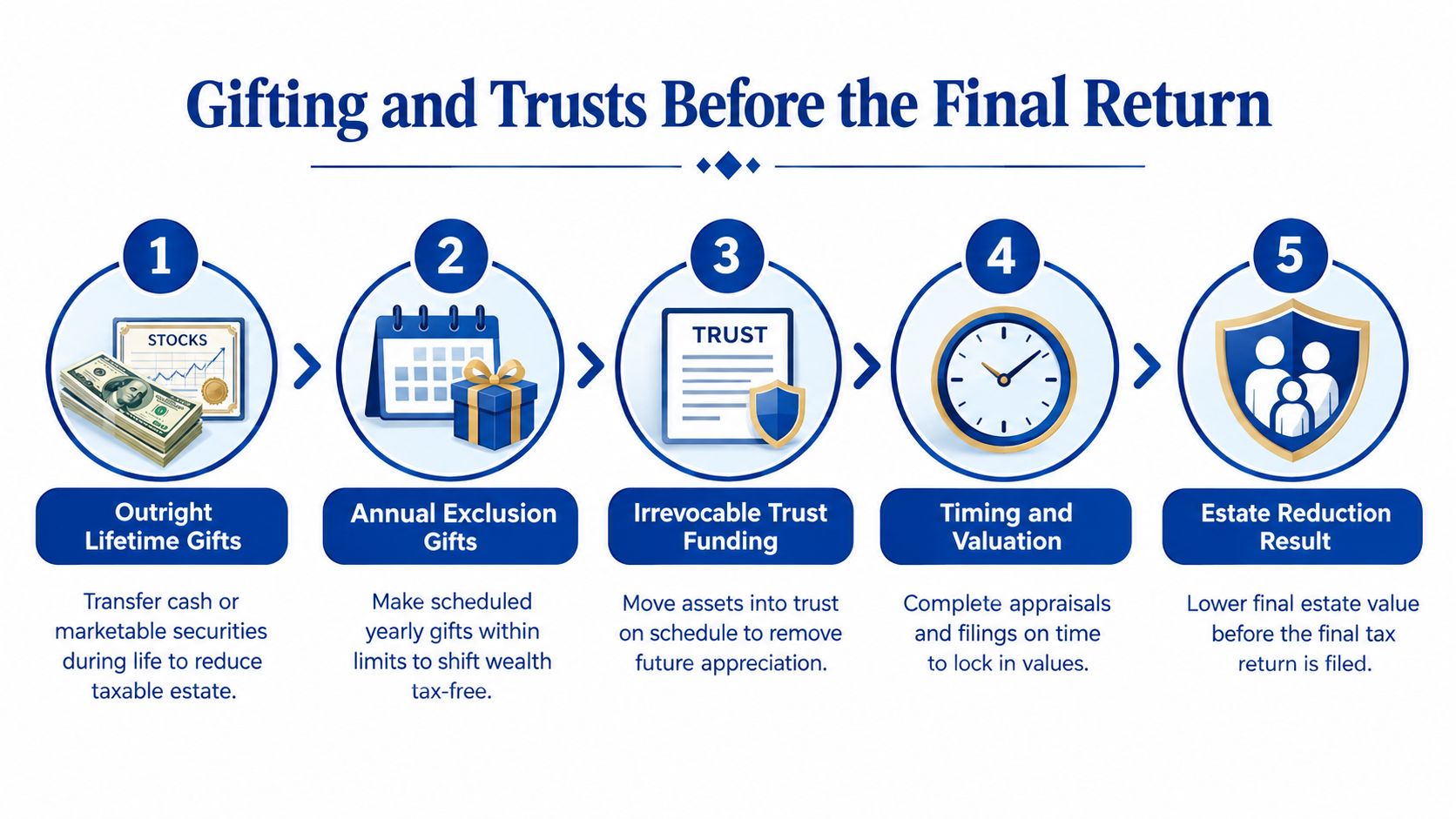
Lifetime planning works best when it begins while you have time to document transfers, obtain valuations, and watch the structure operate. A gift made shortly before death may move legal title while leaving the family with attribution, valuation, or administrative problems.
Gifts need a tax record
An outright gift of cash or marketable securities can remove future growth from the donor’s estate. A gift of appreciated securities can also trigger a disposition at fair market value, so the donor may face tax before the recipient receives the asset. Gifts between spouses can activate attribution rules, and the donor should plan around the applicable survival and attribution requirements rather than assuming the transfer is complete for every purpose.
The recipient’s records matter. Keep the transfer agreement, valuation, adjusted cost base, trade confirmations, and evidence of the intended beneficial ownership. A vague family understanding is poor estate administration.
An alter-ego trust or joint spousal or common-law partner trust may allow a Canadian resident settlor to transfer assets to a trust on a rollover basis where the statutory conditions are satisfied, including the age and beneficiary requirements. The settlor generally needs to be the only person entitled to income and capital during life for an alter-ego trust, while a joint partner trust has its own eligibility requirements.
Trust funding shifts future growth
A prescribed-rate loan to a family trust can shift future investment income and growth outside the lender’s estate when the loan is properly documented and interest is paid on schedule. The structure requires ongoing administration. Missed interest payments can undermine the intended result.
Charitable giving can also reduce the final tax burden. A donation of publicly listed securities to a qualifying charity or private foundation may generate a donation credit based on fair market value and may receive special capital-gain treatment. To claim a donation on the terminal return, the gift must be completed by December 31 of the year of death under the applicable rules.
These strategies need time. They require legal drafting, tax modelling, valuations, trustee records, and clean banking evidence. A transfer made in the year before death may produce less value than a properly designed plan implemented while the family can observe and adjust it.
The best estate reduction strategy is the one you can prove, administer, and explain to the next executor.
Coordinating Corporate and Personal Positions
Consider a composite owner-manager who is 58, owns all common shares of an active Canadian-controlled private corporation, holds a Toronto rental property, and has a $1.4 million taxable investment portfolio. The family may see one balance sheet. Tax law sees several owners, several assets, and several triggering events.
The personal portfolio and rental property can create deemed-disposition tax at death. The rental property may have capital gain and recapture issues. The portfolio may contain securities with a low adjusted cost base. The marital home and RRSP or RRIF may qualify for spousal rollover treatment where the conditions are met, giving the surviving spouse time to manage the broader liability.
The corporation needs a separate map. The shareholder’s shares can be subject to a deemed disposition at death, while the corporation’s underlying assets remain corporate property. A future sale or redemption of the shares can create tax at the shareholder level. An estate freeze can lock in the current value for the existing owner and direct future growth to the next generation or a family trust, subject to proper valuation and legal implementation.
Liquidity is where plans fail
The corporation may have cash, while the estate has the tax liability. A share redemption can provide funds, but the resulting dividend may create double tax unless the corporation has sufficient capital dividend account capacity or another appropriate mechanism. A plan that identifies tax without identifying cash is incomplete.
An alter-ego trust may be considered for shares where the legal and tax conditions fit. It can support control and succession planning, though it doesn’t remove the need to value the shares, document the transfer, and model future corporate distributions.
The owner should also review the shareholder agreement. A buy-sell mechanism, insurance funding, valuation formula, and successor approval process can determine whether the family receives cash, shares, or a dispute.
Strategic tax planning for owner-managers and high-net-worth families should connect the corporation, personal investments, real estate, insurance, wills, and beneficiary designations. Giving the corporate file to one advisor and the personal file to another is how gaps survive.
The corporation and the estate must be drafted as one succession plan. The final return, share structure, and liquidity strategy should agree before death, not after.
What the Executor Actually Has to Do
An executor can inherit a house, investments, registered accounts, and a private company, then discover that the estate has little cash for the tax bill. The work starts with control, evidence, and deadlines. A will names the responsible person, but it does not provide account statements, adjusted cost bases, valuations, or funds for tax.
The first 30 days
Start with the will and a complete asset inventory. Secure the home, cottage, vehicles, digital accounts, corporate records, and investment statements. Notify banks, insurers, financial advisors, and the CRA. Confirm which accounts are joint, which have named beneficiaries, and which require an estate certificate.
In Ontario, the executor may need to apply for a Certificate of Appointment of Estate Trustee. Consider the bonding election as part of that application, particularly where the will, beneficiaries, or family circumstances make bonding relevant.
Record the date-of-death value of every material asset. Private-company shares, rental property, cottages, and securities need evidence that can withstand questions from beneficiaries and tax authorities. Valuations also connect the two major estate charges: tax from deemed dispositions on the final return and Ontario Estate Administration Tax based on estate value.
Days 31 to 60
Gather records for the T1 final return and any T3 trust return. The file should include adjusted cost base records, prior tax returns, corporate ledgers, shareholder agreements, appraisals, and relevant CRA tax information bulletins such as RC4110.
The terminal return reports deemed dispositions at fair market value and claims available spousal or charitable treatment. Identify required elections early. If an optional election such as an RC4288 election may apply, confirm its deadline immediately. A missed election can change the result.
Use a transparent calculation rather than relying on a single headline estimate. In a $1.5 million estate with a $900,000 principal residence, a $400,000 RRIF, and $200,000 of non-registered investments containing $100,000 of embedded capital gains, the RRIF is included in income at death. Applying the stated top marginal-rate assumption produces approximately $185,000 of income tax. The $100,000 capital gain has a 50% inclusion, creating $50,000 of taxable capital gain and approximately $26,750 of tax under the same assumption. Ontario Estate Administration Tax at $15 per $1,000 on $1.5 million produces $22,500, not a figure to accept without checking the applicable formula and estate value. The combined illustration is therefore approximately $234,250, subject to the taxpayer’s other income, deductions, credits, exemptions, and applicable elections. The 2026 estate-planning example shows why the executor needs one consolidated cash-flow schedule, with each assumption documented.
Days 61 to 90
Remit Ontario Estate Administration Tax, prepare beneficiary statements, and track T5 slips issued to the estate. Once the terminal and trust returns are filed, request a clearance certificate from the CRA and hold back final distributions until it arrives. The executor remains personally liable for unpaid tax.
Common failures are practical:
- Missed elections: A spousal rollover or other election may require a deadline-driven filing decision.
- Low private-company valuations: A family-friendly value can fail under tax review.
- Unclear estate elections: The executor may fail to make a required election out of graduated-rate-estate treatment in writing.
- Late remittance: Probate tax paid late can create interest or penalty exposure.
For complex estates, CPA support for complex tax situations in the GTA can organise the final return, trust filings, valuation records, and executor communication. Legal drafting remains a lawyer’s role. The executor needs both disciplines working from the same asset list.
Pulling the Pieces into One Plan
Estate tax planning becomes useful when it produces a calendar, an ownership map, and a funding answer. The deemed disposition and Ontario probate levy are separate rules, but the family experiences them together. They can both reduce the cash available to beneficiaries after death.
Start with title. A cottage may need joint ownership with a spouse if immediate access and survivorship are intended. A small brokerage account may remain directly owned so the will controls the distribution and the executor can use final-return losses where permitted. A rental property may belong in a trust or corporate structure if control, liability, and succession justify the added administration.
Then review whether tax should be deferred, shifted, or recognised earlier. A pipeline from a holding corporation, an estate freeze, or a prescribed-rate loan may bring future growth outside the original owner’s estate when the legal and tax conditions support the structure. The purpose is liquidity and control, not a clever transaction that the family cannot explain.
Gifts should be made while the donor can document the transfer and survive the relevant attribution and administrative requirements. Future appreciation has more chance to accrue outside the estate when the plan is implemented early. A gift made under pressure shortly before death may create more work than value.
A practical planning calendar
- Review the will now: Confirm executors, trustees, guardians, beneficiary designations, and the treatment of the cottage, business shares, and registered plans.
- Review the shareholder agreement this quarter: Check valuation language, redemption rights, insurance, successor approval, and death provisions.
- Implement a freeze before December 31 where appropriate: Obtain the valuation, draft the documents, and confirm the corporate and personal tax effects before signing.
- Gift surplus cash over the next three tax years: Transfer only what the donor can afford, document each transaction, and monitor attribution and reporting.
- Bring the records to one meeting: Take the last two T1 returns, the share ledger, the current will, corporate financial statements, investment statements, and property valuations.
The family doesn’t need every strategy. It needs the right ownership, the right rollover, the right valuation, and enough liquidity to pay the final return without selling the wrong asset.
If you’re unsure whether your will, corporate structure, and beneficiary designations work together, bring the last two T1 returns, the share ledger, and your current will to a planning meeting before year end. C&P Partners CPA offers coordinated personal and corporate tax planning, estate administration support, and valuation work for GTA owner-managers and families. Visit C&P Partners CPA to start that conversation.