

Estate Administration Tax Calculator Guide

Ontario estates valued at $50,000 or less pay zero estate administration tax. Amounts above that threshold are taxed at $15 per $1,000 of the excess value.
You’re the executor, and you’re working through a list of bank accounts, investments, property, debts, and ownership records. The natural assumption is that Ontario takes a flat percentage of everything the deceased owned. That assumption made sense under the older fee schedule. It can lead you to reserve too much cash or use the wrong figure in the estate certificate application.
The current standard is clear. Calculate the probate-relevant estate value in Canadian dollars, subtract the $50,000 exemption, round the taxable portion up to the next $1,000, then apply $15 for each $1,000. A calculator result helps, but it doesn’t decide whether probate is required or whether an Information Return remains necessary.
The Core Calculation Rule for Ontario Executors
You’re likely staring at an asset list and asking a practical question: how much money must the estate set aside for Ontario’s court application?
The reasonable assumption is that the province charges a flat fee against the entire estate. Older Ontario rules did apply a charge to the first portion of the estate, so that assumption didn’t come from nowhere. The current rule changed on January 1, 2020, and the exemption now drives the calculation. Ontario’s estate administration tax guidance confirms the current structure.
Start with the amount above the exemption
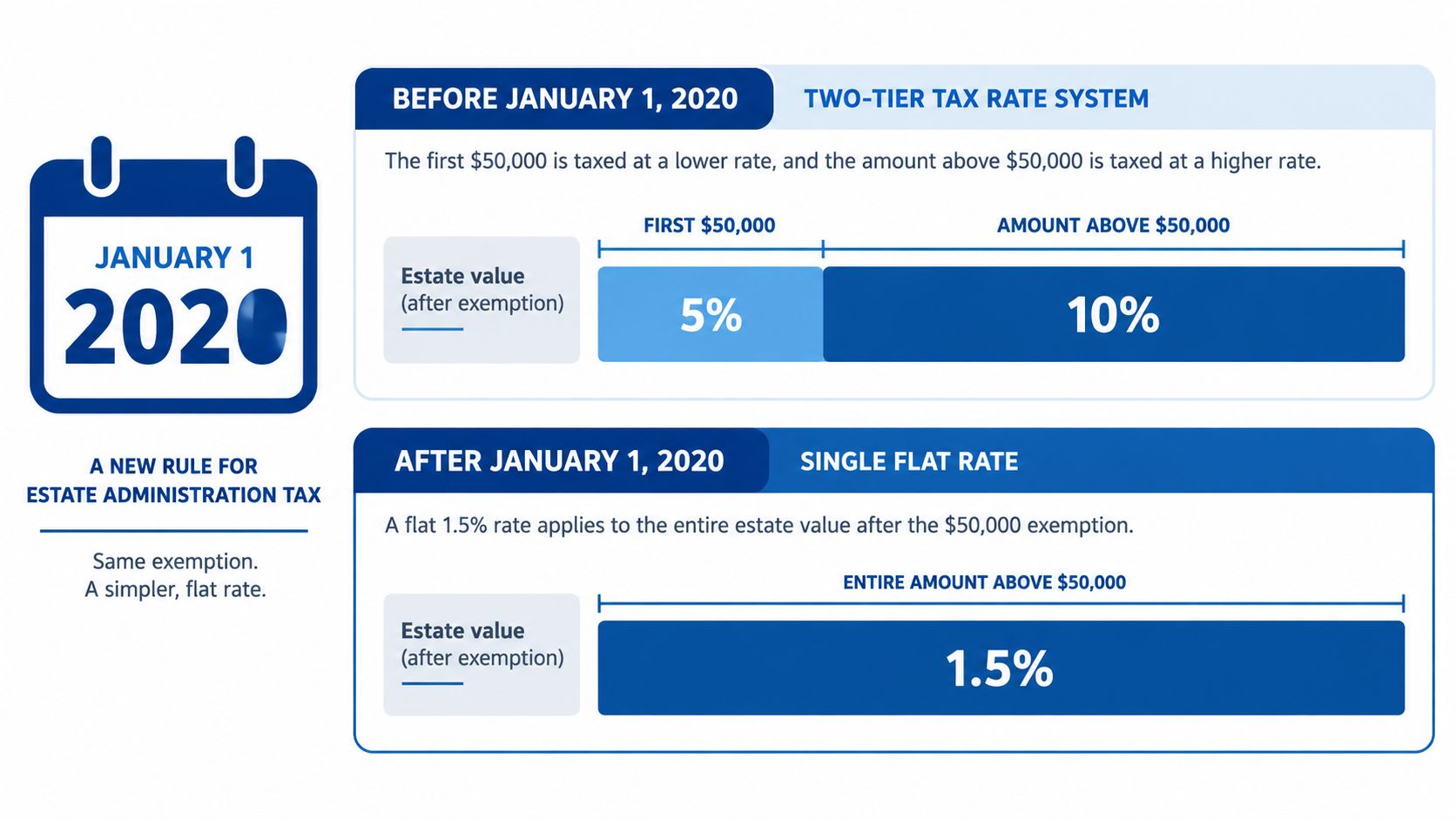
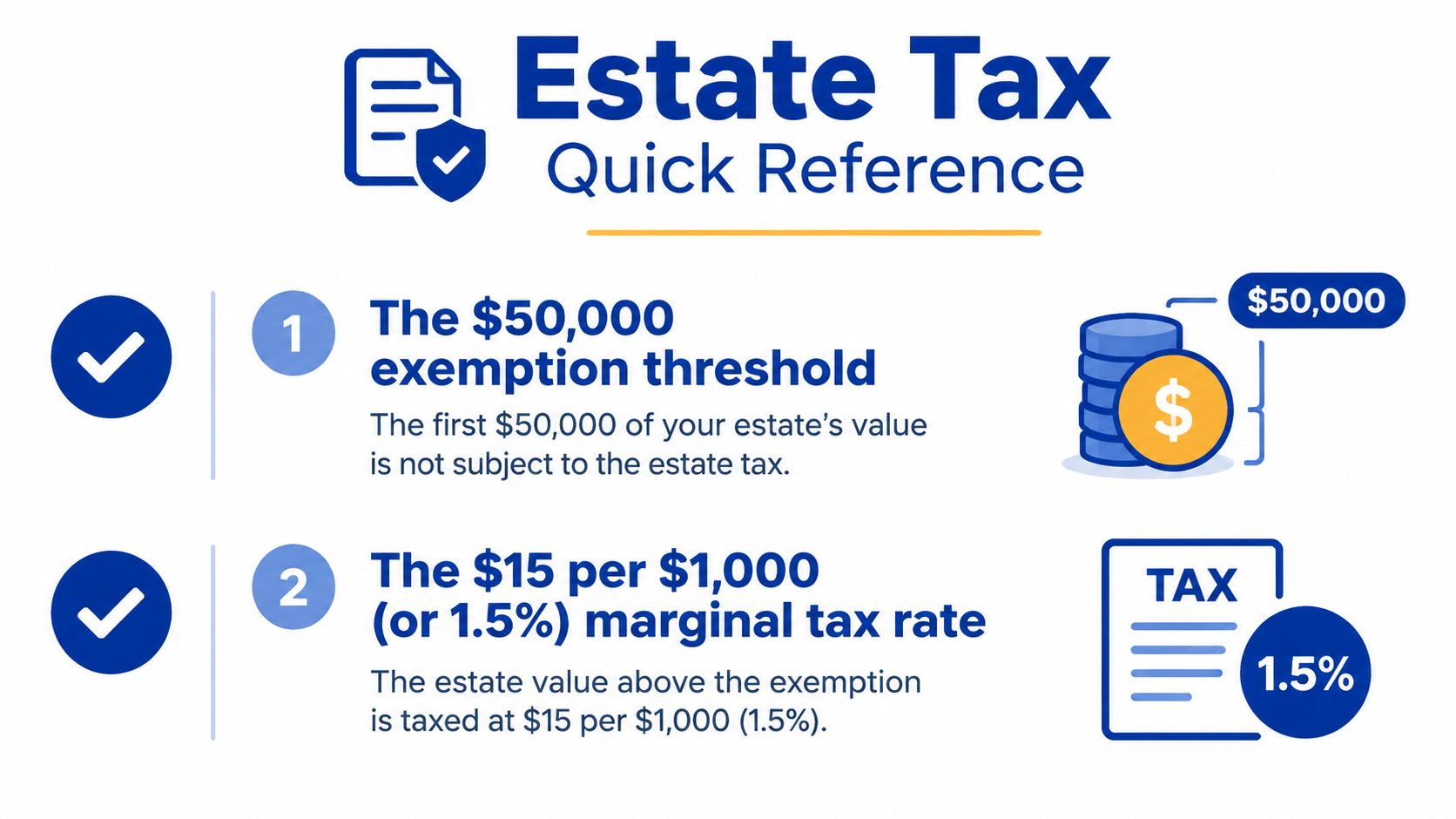
Ontario estates valued at $50,000 or less owe $0. For an estate above that amount, only the value exceeding $50,000 is taxable. The rate is $15 per $1,000, or part of $1,000, of that excess value. That is effectively 1.5% of the value above the threshold, subject to the rounding rule discussed below.
Use this sequence:
- Identify the probate-relevant estate value. Use the date-of-death value and deduct actual permitted encumbrances.
- Subtract $50,000. If the result is zero or negative, the tax is zero.
- Round the excess up to the next $1,000.
- Multiply each $1,000 by $15.
The result is an estimate of estate administration tax. It isn’t a complete probate budget. Legal fees, valuation work, document collection, and court administration still affect the estate’s workload and cost.
Practical rule: Keep the calculation separate from the probate decision. A tax estimate tells you the likely tax if an estate certificate is required. It doesn’t prove that every asset must pass through probate.
This baseline prevents a common mistake. If you apply 1.5% to the entire estate, you overstate the tax for smaller estates and misstate the amount for every estate because the exemption applies first. The province’s calculator exists for this reason, and the official guidance directs users to it when estimating the amount payable.
How the $50,000 Exemption Changes the Math
The current rule reflects a material change that took effect on January 1, 2020. Before then, Ontario charged $5 per $1,000 on the first $50,000 and $15 per $1,000 above $50,000. The reform removed the lower-bracket charge while leaving the marginal rate above the threshold unchanged. TaxTips.ca’s Ontario probate fee summary reproduces the current and former schedules.
That history matters when you’re reading an older will, estate plan, spreadsheet, or family memo. A document prepared before the reform may show a probate amount for an estate at or below the threshold. That amount may no longer apply under the current schedule.
Three examples show the effect
A $50,000 estate owes $0 today. Under the former schedule, it owed $250, calculated at $5 per $1,000 on the first $50,000.
A $100,000 estate owes $750 under the current rule. Only $50,000 is above the exemption, so the calculation is $50,000 divided into $1,000 units, multiplied by $15.
A $250,000 estate owes $3,000. The taxable portion is $200,000, and the rate applies only to that amount.
For a $1,000,000 estate, the current tax is $14,250. The taxable portion is $950,000. The higher estate value makes the calculation more significant, even though the marginal rate hasn’t changed since the reform.
Why the change matters to cash planning
The exemption protects smaller estates from the former lower-bracket charge. Larger estates still need a proper liquidity forecast because the marginal rate continues to apply to the value above the threshold. A family dealing with a modest estate may focus too heavily on the tax amount and miss the administrative question. A family with substantial property, securities, or private-company shares needs both calculations.
Use the current schedule when preparing the estate certificate application. Don’t rely on an old spreadsheet because it was prepared by a lawyer, adviser, or family member.
The Rounding Rule That Catches Executors Off Guard
Many individuals reach for a calculator and multiply the taxable value by 1.5%. That gives a useful rough estimate, but it can miss the statutory treatment of a partial thousand.
Ontario’s rule is $15 per $1,000, or part of $1,000, above the exemption. The Ontario government calculation page therefore requires the taxable portion to be rounded up to the next $1,000 before the rate is applied.
Use the statutory sequence
Suppose the probate-relevant estate value is $150,001.
The first $50,000 is exempt. The taxable portion is therefore $100,001. You don’t apply 1.5% to the exact $100,001. You treat that amount as 101 units of $1,000, because the final $1 is part of the next thousand.
The tax is therefore 101 multiplied by $15.
That result is higher than an exact-proportion calculation by an amount that can reach $15, because the final partial thousand is charged as a full unit. This difference may be small beside the total estate, but it matters when you’re reconciling an automated estimate to the official formula.
Check what your software is doing
Ask three questions before accepting a calculator result:
- Does it subtract the exemption first? Applying the rate to the full estate produces the wrong base.
- Does it round the excess upward? A decimal multiplier may fail to charge for a partial $1,000.
- Does it show the working? You should be able to trace the estate value, deductions, exemption, rounded amount, and final tax.
A manual calculation is valuable even when you use the government’s tool. It gives you a reconciliation point and exposes data-entry mistakes before the application is filed.
A calculator is only as reliable as the estate value and rounding method behind it.
Keep a copy of the calculation with the estate records. If an asset value changes because the date-of-death evidence was corrected, update the calculation and preserve the reason for the change.
Separating Gross Assets from Probate Value
The largest calculation error often occurs before anyone applies the rate. An executor takes every asset associated with the deceased, adds the balances together, and enters the total into an estate administration tax calculator.
Ontario’s taxable base uses the value of estate assets required to be disclosed under section 32 of the Estates Act, less actual encumbrances. The Estate Information Return guide sets out the asset-value and encumbrance requirements.
Build a probate-focused inventory
The distinction is practical. A mortgage attached to estate-owned real estate may be an actual encumbrance that reduces the relevant value. An asset held jointly with a right of survivorship may pass outside the estate, depending on the ownership facts and the nature of the asset.
You need evidence for both conclusions. Title records, account statements, loan documents, shareholder records, beneficiary designations, and valuation support should sit behind the number.
| Asset Type | Included in Calculator | Reasoning |
|---|---|---|
| Solely owned real estate | Generally, yes | It forms part of the estate value, subject to actual encumbrances and the relevant ownership facts. |
| Solely owned bank or investment accounts | Generally, yes | The date-of-death value is part of the estate inventory. |
| Joint asset passing by right of survivorship | May be outside the estate | The ownership arrangement may transfer the asset outside the estate, so the legal facts must be confirmed. |
| Real estate with a mortgage | Value may be reduced by the actual encumbrance | The provincial guidance permits deductions for actual encumbrances. |
| Private-company shares | Requires support for ownership and value | The estate may need a defensible valuation before the application is submitted. |
A private-company interest deserves particular care. If you need a formal valuation for estate administration, business valuation services in Milton, Ontario can help establish a supportable value for the shares.
Don’t confuse the gross asset list with the probate base. The correct question is which assets form part of the estate for this calculation, what they were worth on the date of death, and which actual encumbrances can be deducted.
Why the Tax Rate Is Rarely the Biggest Cost
Executors often focus on the 1.5% marginal rate because it’s easy to see. The more difficult cost is the work required to determine whether a full probate application is needed and, if it is, how much documentation the court will require.
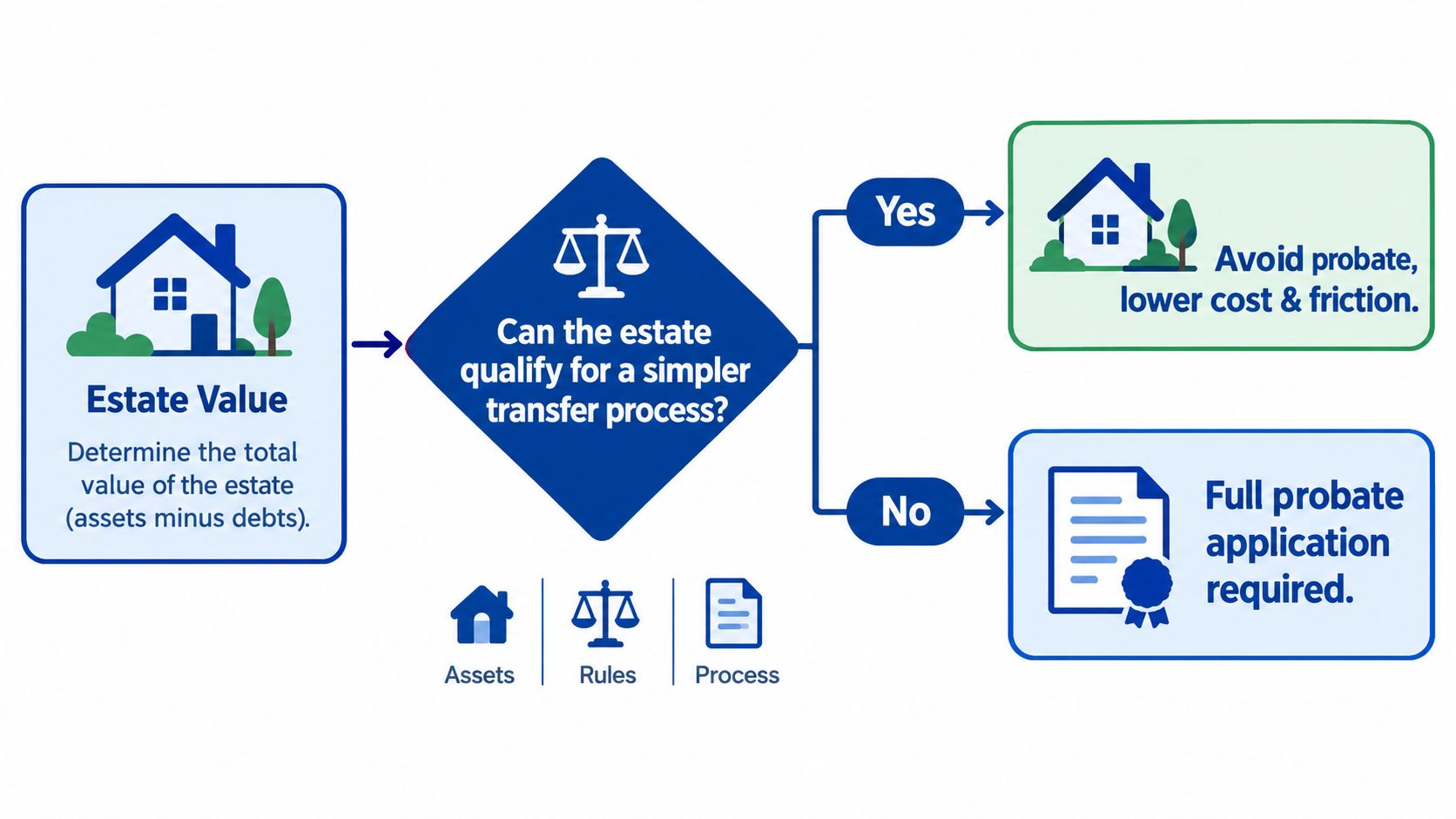
Ontario’s small-estate regime can change that assessment. Independent Ontario sources note that estates under $150,000 may qualify for a simplified small-estate certificate process, while the tax estimate still follows the provincial calculation. The threshold for the simplified process and the tax exemption answer different questions.
Separate tax from administrative burden
An estate can have a low tax result and still require careful work. You may need to gather account confirmations, establish ownership, obtain date-of-death values, document encumbrances, prepare affidavits, and deal with court processing.
For a smaller estate, the tax may be modest. The time and professional cost associated with a full application can matter more. That’s why you should assess the certificate route before treating the tax estimate as the main planning issue.
Ask whether probate is required
A calculator can estimate tax when an estate certificate is applied for. It can’t determine whether a bank, land registry, investment institution, or other holder will insist on a certificate before transferring an asset.
That decision depends on the asset, the ownership structure, the institution’s requirements, and the estate documents. You should therefore make two separate decisions:
- Tax estimate: What amount follows from the probate-relevant estate value?
- Process assessment: What certificate, if any, is needed to access or transfer the assets?
Avoiding a full application may reduce paperwork, delays, and professional fees. It may also require stronger evidence that an asset passes outside the estate or that a simplified process applies. Don’t restructure ownership after death without legal advice. At that point, the executor is administering facts that already exist.
Compliance Requirements When the Tax Is Zero
A zero result on the estate administration tax calculator doesn’t mean the file is complete. Ontario’s Estate Information Return guide explains that an Information Return may still be required even when no estate administration tax is payable.
That distinction matters for estates at or below the exemption. You can owe no tax and still have to report the estate information, support the values, and meet the applicable filing requirements. The calculator answers the tax question. It doesn’t erase the reporting obligation.
Value the estate at the date of death
The relevant values come from the date of death, rather than a later market date. That timing matters when listed securities or real estate move in value after death. A later sale price may help explain an outcome, but it isn’t automatically the correct value for the estate tax calculation.
Preserve the source of each material figure:
- Financial accounts: Keep statements or confirmations showing the balance at the date of death.
- Securities: Retain the valuation evidence used for the date-of-death amount.
- Real estate: Keep the appraisal or other valuation support and identify any encumbrance.
- Private-company interests: Document the ownership and valuation method.
- Joint assets: Retain records showing the ownership arrangement and transfer terms.
The file should show how you moved from the asset records to the reported estate value. That audit trail protects the estate trustee and makes a later review easier.
File discipline matters: A zero tax result still needs an explainable calculation.
Use a calendar that tracks estate administration steps alongside tax work. A practical review of CRA deadlines can help you avoid treating the provincial tax estimate as the only deadline in the file.
If the estate value later changes because you found an omitted asset or corrected an encumbrance, revisit the Information Return and the tax calculation. Don’t assume the original zero result remains correct.
Quick Reference for Estate Tax Calculations
When you’re ready to verify the figure, keep the calculation simple and keep the evidence beside it. Ontario’s current structure has three moving parts: the exemption, the rounded taxable amount, and the definition of estate value.
The calculation checklist
- Confirm the date of death. Use values from that date, rather than a later market date.
- List probate-relevant assets. Separate estate assets from assets that may pass outside the estate.
- Identify actual encumbrances. Support each deduction with the relevant loan or security records.
- Calculate the estate value in Canadian dollars. Don’t mix gross values with the probate base.
- Apply the $50,000 exemption. Estates at or below the threshold produce a zero tax result.
- Round the excess upward. Any part of a $1,000 counts as a full $1,000.
- Apply $15 per $1,000. This is the current marginal rate above the threshold.
- Save the working papers. Keep the records that support values, deductions, and ownership.
The errors that deserve a second review
Check for an old probate schedule in the will file. The pre-2020 lower-bracket charge can create an outdated estimate.
Check for an exact-percentage calculation that ignores the partial-thousand rule. The difference may be as much as $15, and the reason should be clear when you reconcile the numbers.
Check for a gross asset total that includes joint property without reviewing the ownership documents. Check for a later sale price used in place of the date-of-death value. Each error changes the estate value before the rate is applied.
The official Ontario calculator is a useful final check. It shouldn’t replace a documented asset inventory.
Moving from Calculation to Estate Strategy
Running the numbers is the first decision point. It tells you the likely Ontario tax based on the estate value and the current formula. It doesn’t tell you how the deceased’s ownership structure affects probate, whether a private-company valuation is defensible, or whether an estate plan still reflects the family’s intentions.
That broader review matters most when the estate includes a corporation, rental property, investment holdings, or assets with different beneficiary and ownership arrangements. A simple personal account may be easy to classify. Shares in a private company can require valuation work. Joint ownership can require legal review. Beneficiary designations need to be checked against the estate plan and the surrounding facts.
Know when the calculator is insufficient
Move beyond a simple estimate when:
- The estate includes a private corporation. The share value may require formal support for estate administration or a related transaction.
- Ownership records conflict. A joint account or property title may not answer the transfer question by itself.
- The estate has significant real estate. Date-of-death value, mortgages, and title records need to align.
- The family is planning ahead. Estate freezes, joint ownership structures, and beneficiary designations can affect future administration, but each requires advice based on the family’s facts.
- The executor is unsure about the certificate route. The tax estimate and the probate requirement should be assessed separately.
Estate planning decisions are difficult to reverse after a death. A low calculator result shouldn’t encourage you to ignore the ownership structure. A high result shouldn’t lead you to transfer assets casually. Legal, tax, valuation, and family considerations need to be reviewed together.
C&P Partners CPA offers personal tax work that includes estate and succession tax planning, along with formal business valuations for estate administration. If the situation involves several entities, ownership questions, or other non-standard tax issues, CPA support for complex tax situations in the GTA may be appropriate.
If you’re unsure which assets belong in the probate calculation, what values support the estate return, or whether the estate needs more than a basic estimate, that’s exactly the kind of conversation worth having before the application is filed.
C&P Partners CPA can help you organise the asset inventory, review date-of-death values and encumbrances, and connect estate administration with succession and tax planning. Visit C&P Partners CPA to start a conversation about the estate facts that need to be settled before you rely on the calculator.